

Ebun Francis|
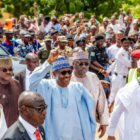
President Muhammadu Buhari on Friday explained that his long distance trek on Sallah day was not about his physical fitness but to show respect to thousands of people who wanted to greet him.

Garba Shehu, the senior special assistant to the president on media and publicity, had in a statement earlier in the week said by trekking a distance of 800 meters, Buhari showed his fitness to seek another term.
The comment elicited mixed reactions on social media and from politicians from the opposition Peoples Democratic Party (PDP).

But speaking when he received some socio-political groups at his private residence in Daura, Katsina state, the President said his walk had nothing to do with his bid to seek re-election.
The President said, “Let me react to some media reports about my trekking on Sallah day insinuating that I trekked to demonstrate my fitness for 2019 presidential election.”
‘‘They were not seeing me so I came down so they could see me. I didn’t need to convince anyone about my health and the decision to contest for a second term- a decision that I made public in April this year.
“After the prayer, I noticed that many people wanted to see and I was in a black vehicle and security men were blocking them from seeing me.
“So, I opted to trek in spite the security implications because I knew nothing would happen to me by the grace of Allah.”
President Buhari also used the opportunity of his meeting with his kinsmen to inform them that he has directed the ministry of agriculture and the CBN to review the processes on the issuance of loans to smallholder farmers.
He said, “We want to make it easier for them to assess the loans, particularly the underprivileged people in the society.”
“It has become necessary for the government to do this because banks will insist on collaterals which majority of farmers do not have.
“For our agriculture policy to succeed, we must be able to reach smallholders farmers with loans without collaterals. Collateral are always a problem with smallholder farmers.’’