

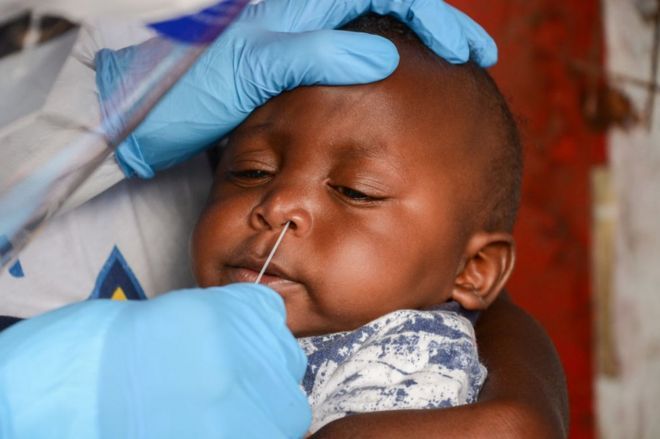
Chidi Samuel| Nigeria on Friday confirmed 329 new cases of #COVID19 bringing the countrys toll to 48,445 cases.
The Nigeria Centre For Disease Control in a Tweet via its verified Twitter handle said the new infections were recorded across 20 states and the FCT with Lagos the pandemic epicentre recording 113 new cases, followed by Kaduna-49, FCT-33, Plateau-24 and Kano-16.
Other states with new infections include, Edo-15, Ogun-14, Delta-13, Osun-10, Oyo-8, Ekiti-6, Bayelsa-6, Akwa Ibom-5, Borno-4, Enugu-4, Ebonyi-3, Rivers-2, with
Bauchi, Nasarawa, Gombe and Niger recording 1 case each.
According to the health agency, Nigeria currently has 48,445 confirmed cases of the novel coronavirus with 35,998 discharges, and 973 deaths.

-Over 800 million children worldwide risk contracting COVID-19 — UNICEF
Meanwhile, the UN Children’s Fund (UNICEF) says 818 million children worldwide are at risk of getting infected with COVID-19 and other infectious illnesses.
Mark Hereward, UNICEF’s Associate Director, Data and Analytics Division, Planning and Monitoring, made this known in a statement on Thursday.
Mr Hereward stated that latest data from the World Health Organisation (WHO) and UNICEF Joint Monitoring Programme (JMP), shows that two in five schools worldwide lacked basic handwashing facilities prior to the Coronavirus outbreak.
He said this puts 818 million children at risk of contracting the virus and other diseases.
He added that “the risk is particularly high for children in Least Developed Countries, where seven out of 10 schools lack basic handwashing facilities and half of schools lack basic sanitation and drinking water.”
The director noted that school closures around the world had so far affected up to 1.6 billion children, presenting an unprecedented challenge to their education and wellbeing.
He said, “In order to prioritise children’s learning and safety, authorities must ensure schools are safe to reopen by focusing on access to soap and water, clean drinking water and safe sanitation.
“Handwashing, using soap and water is one of the most effective ways of preventing the spread of diseases, including COVID-19.
“It is also a key condition for schools to be able to reopen and operate safely in the midst of the ongoing pandemic.
“Access to these services is essential for effective infection prevention and disease control in all settings, including schools,” Mr Hereward added.
With NAN report