

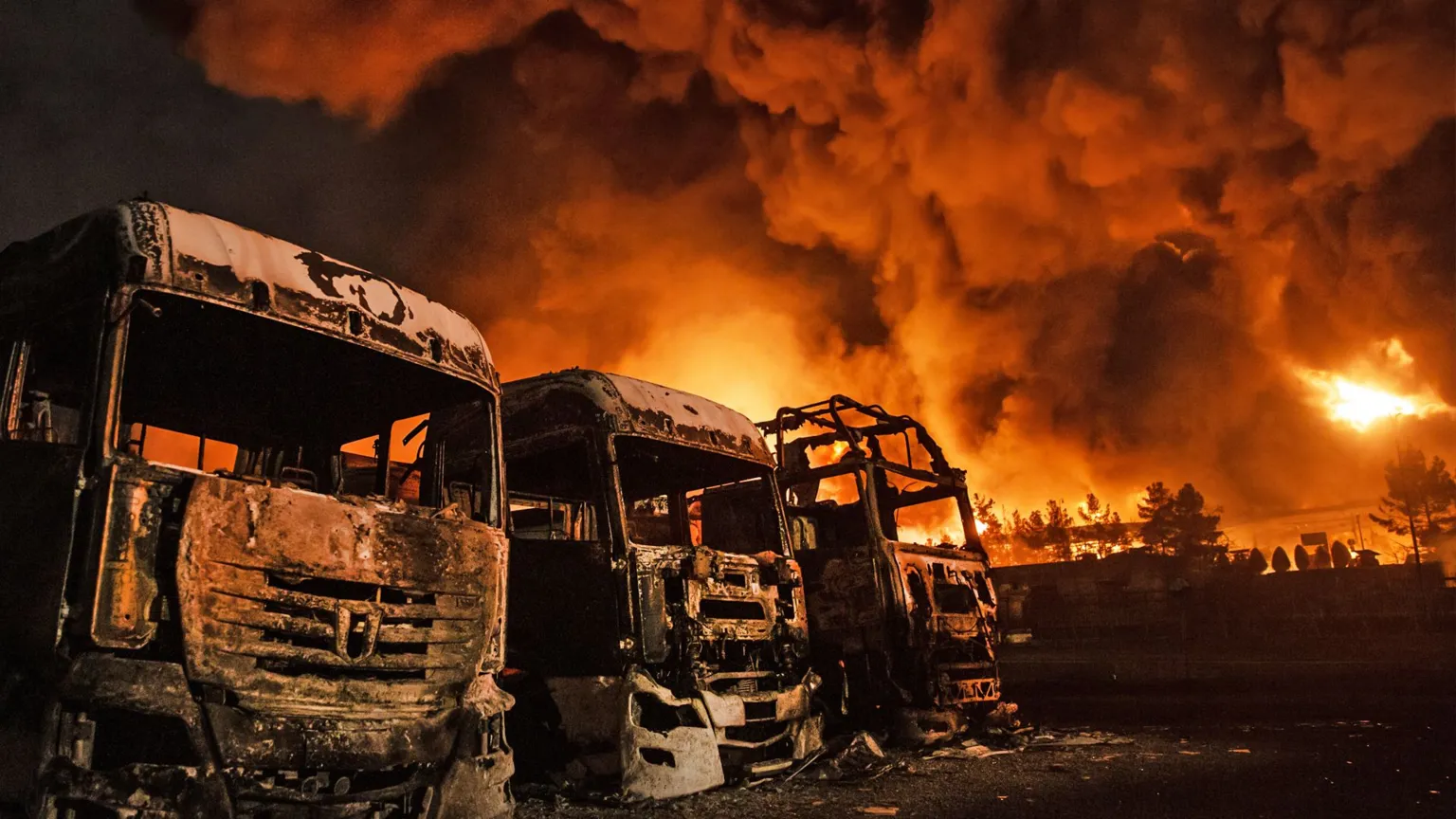
Satellite imagery from Maxar and Planet Labs, analysed by researchers at the Middlebury Institute and the Institute for Science and International Security, shows significant damage at the Taleghan-2 facility inside Iran’s Parchin military complex following strikes on 9-10 March. The weapon signature is consistent with the GBU-57 Massive Ordnance Penetrator, a 30,000-pound bomb designed to penetrate up to 200 feet of hardened concrete, delivered by B-2 Spirit stealth bombers deployed from Whiteman Air Force Base in Missouri.
Parchin is not an oil depot. It is not a naval base. It is not a drone warehouse. The IAEA’s November 2011 report identified the site as the location of hydrodynamic experiments consistent with nuclear weapon development, specifically high-explosive testing for implosion-type nuclear initiators, the component that compresses fissile material to achieve critical mass. Israel released 55,000 pages from Iran’s Amad Plan archive in 2018 documenting Parchin’s role. The IAEA detected chemically man-made uranium particles during its sole inspection of the specific site in September 2015. Iran then denied access and undertook sanitisation activities that the IAEA said “undermined verification.”

The war that began as a decapitation strike against a Supreme Leader has crossed into the nuclear domain. Not because a nuclear weapon was used. Because the facility suspected of developing them was struck with the most powerful conventional munition in the American arsenal.
The GBU-57 exists for one purpose. It was designed during the Obama administration specifically to hold at risk Iran’s deeply buried nuclear facilities. It weighs more than most fighter aircraft. Only the B-2 can deliver it. And the B-2 flew from Missouri to Iran and back, a round trip of approximately 25,000 kilometres, to put it through the roof of a building that the IAEA spent fifteen years trying to inspect and Iran spent fifteen years trying to hide.

Iran’s response calculus just changed. Before Parchin, the war was about sovereignty, oil, and regional power. After Parchin, the war is about whether Iran still possesses the capability to develop a nuclear weapon. A regime under existential bombardment that believes its nuclear option has been destroyed has two choices: surrender or accelerate. The intelligence community assesses the regime is not collapsing. The Mosaic Doctrine’s 31 commands continue operating. Continuous strikes have been announced. If the regime concludes that its nuclear hedge has been removed by the Parchin strike, the incentive to reconstitute covertly at undeclared sites becomes the single most dangerous variable in international security.
Every nation that has calculated its security based on the assumption that Iran was months away from a nuclear weapon is now recalculating. Israel struck Parchin to eliminate the threat. The strike may instead have eliminated the deterrent. A nuclear-capable Iran that refrains from building a weapon because the option exists is strategically different from a non-nuclear Iran that races to build one because the option has been bombed.
The war cost $11.3 billion in six days. The Strait carries 8 tankers instead of 138. Dubai’s towers burn from interception debris. Oman’s mediator port is on fire. The intelligence community says the regime is stable. And the largest conventional bomb on Earth just landed on the facility where the IAEA found man-made uranium particles.
The war is no longer about oil. It is about physics. And physics does not negotiate.
Shanahan Anslem P @shanaka 86 published this on X [ formerly Twitter]