

The price of crude oil has fallen sharply, after Iran’s foreign minister said the Strait of Hormuz would be completely open to commercial shipping for the “remaining period of ceasefire.”
Following the announcement, the cost of a barrel of Brent crude fell to below $90 a barrel, having been above $98 earlier in the day.

NYMEX light sweet crude, the US benchmark, also dropped significantly.
Before the conflict, Brent crude was trading at just below $70 a barrel. It rose above $100 in early March and peaked at more than $119 later that month.

Meanwhile, President Trump while confirming that the Strait of Hormuz is completely open for business, however, said that US blockade of Iran’s ports will remain.
Strait of Hormuz is “COMPLETELY OPEN AND READY FOR BUSINESS”, Trump said in Truth Social media post.
He goes on:
“BUT THE NAVAL BLOCKADE WILL REMAIN IN FULL FORCE AND EFFECT AS IT PERTAINS TO IRAN, ONLY, UNTIL SUCH TIME AS OUR TRANSACTION WITH IRAN IS 100% COMPLETE.
“THIS PROCESS SHOULD GO VERY QUICKLY IN THAT MOST OF THE POINTS ARE ALREADY NEGOTIATED. THANK YOU FOR YOUR ATTENTION TO THIS MATTER! PRESIDENT DONALD J.TRUMP”.
What is the Strait of Hormuz, why does it matter?
It’s a critical shipping route through which roughly 20% of the world’s oil and natural liquefied gas is transported.
The strait’s geography has allowed Iran to use it as leverage throughout this war, selectively preventing vessels from passing through the narrow waterway and spiking oil prices in the process.
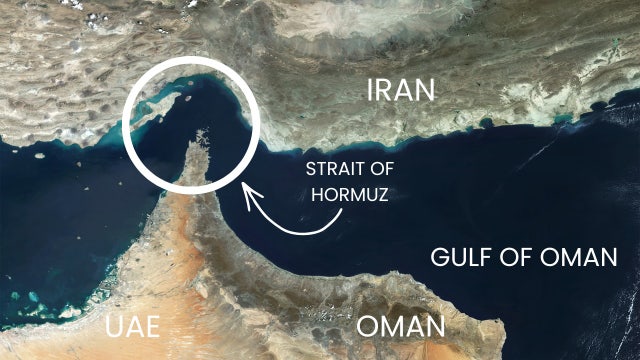
Bounded to the north by Iran and to the south by Oman and the United Arab Emirates (UAE), the corridor – only about 50km (31 miles) wide at its entrance and exit, and about 33km wide at its narrowest point – connects the Gulf with the Arabian Sea.
The strait is deep enough for the world’s biggest crude oil tankers, and is used by major Middle Eastern oil and LNG producers, as well as their customers.
In 2025, about 20 million barrels of oil and oil products passed through the Strait of Hormuz per day, according to estimates from the US Energy Information Administration (EIA). That is nearly $600bn (£447bn) worth of energy trade per year.
The oil comes not only from Iran but other Gulf states such as Iraq, Kuwait, Qatar, Saudi Arabia and the UAE.