

By Kio Amachree
Nigeria is not merely broke. Nigeria is being drained.

Since President Bola Tinubu took office, the public record has become a ledger of unanswered questions: missing oil revenues, unaccounted public funds, abandoned projects, opaque debt write-offs, and audit queries that would bring down governments in serious countries.
The exact amount stolen has not been proven in court. But the amount unaccounted for, disputed, queried, or flatly unexplained is staggering — and it grows with every passing month.

Start with NNPCL and the Federation Account.
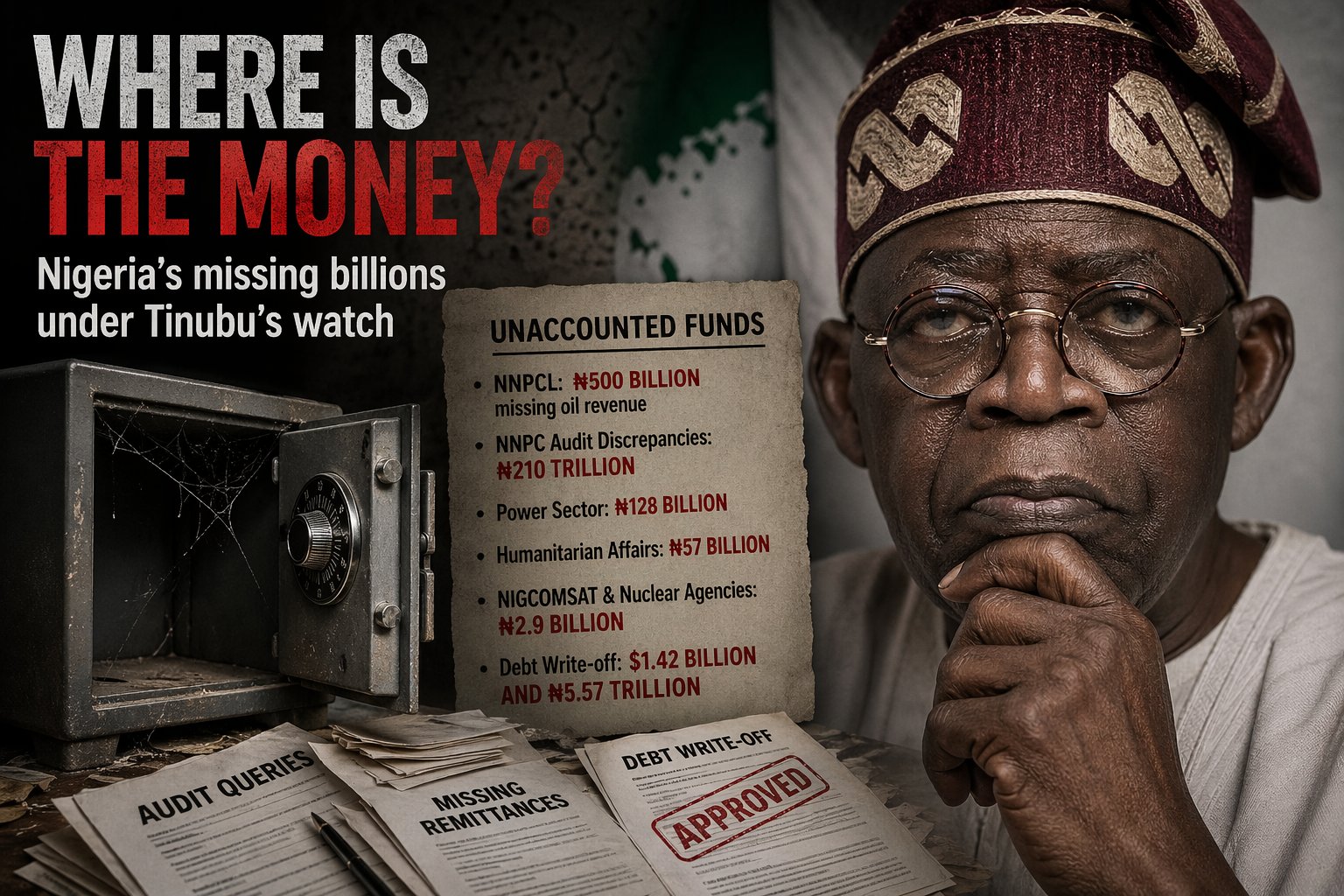
The World Bank revealed that out of ₦1.1 trillion earned from crude oil sales and other income in 2024, NNPCL remitted only ₦600 billion — leaving ₦500 billion unaccounted for. SERAP has since filed suit at the Federal High Court in Lagos, seeking a court order compelling NNPCL to explain the whereabouts of the missing funds, identify those responsible, and hand over suspects to the EFCC and ICPC. NNPCL’s response, delivered through its lawyers, was to argue that the Freedom of Information Act does not apply to it. The Supreme Court has already ruled otherwise.
That ₦500 billion is only the most recent entry in a much longer ledger. A separate SERAP lawsuit, citing the 2021 Auditor-General’s report published in November 2024, seeks to compel NNPCL to account for ₦825 billion and $2.5 billion in funds designated for refinery rehabilitation — money that the Auditor-General fears may be missing. Meanwhile, despite $18 billion reportedly spent on Nigeria’s refineries, Aliko Dangote himself has said they may never work again.
Then there is the Senate.
The Senate Public Accounts Committee has given NNPCL a deadline of April 29, 2026 — today — to appear before it and account for ₦210 trillion flagged in audit reports spanning 2017 to 2023, comprising ₦103 trillion in accrued expenses and ₦107 trillion in receivables.The Senate declared its dissatisfaction with the explanations provided, noting that NNPCL claimed ₦103 trillion was paid in cash to joint ventures in a single year — despite the fact that cash call arrangements were abolished in 2016 and the company generated only ₦24 trillion in total revenue over five years.The committee has now threatened to exercise its coercive powers, and Senator Wadada has hinted that Tinubu himself may be summoned to answer questions in his capacity as Minister of Petroleum Resources.
Beyond NNPCL, there is the older and even larger shadow of $42.37 billion. The Nigeria Governors’ Forum commissioned Periscope Consulting, which found that NNPCL failed to remit approximately $42.37 billion in oil revenue to the Federation Account between 2011 and 2017. As of the FAAC Post-Mortem Report for February 2026, NNPCL and Periscope Consulting had still failed to agree on a reconciled figure — a dispute that sits entirely separate from the ₦210 trillion discrepancy under National Assembly investigation.
And then there is the write-off. Tinubu approved the cancellation of $1.42 billion and ₦5.57 trillion in NNPCL debts to the Federation Account, presented as a bookkeeping resolution. Yet new statutory obligations of $56.8 million and ₦1.02 trillion were already accumulating on the books within months of that decision. The debt was forgiven. The habits were not.
SERAP has separately identified further gaps: ₦5.9 billion reportedly spent on the rebranding exercise that turned NNPC into NNPCL, with senators questioning transparency on retention fees, legal fees, and incorporation expenses that appear in the accounts without adequate explanation.
This is the pattern.
Nigeria borrows. Nigeria budgets. Nigeria announces reforms. Nigeria removes subsidies. Nigeria taxes the poor. Nigeria devalues the currency. Nigeria tells citizens to endure pain.
But when the people ask where the money went, they are given grammar.
Audit queries are not grammar. Missing remittances are not grammar. Refinery money gone without functioning refineries is not grammar. A hungry child in Kano, a market woman in Lagos, a pensioner in Port Harcourt, and a graduate without work in Enugu cannot eat fiscal excuses.
There is a direct line between every naira that vanishes into NNPCL’s opaque accounts and every state government that cannot pay teachers, maintain roads, or stock a hospital. The Federation Account is not an abstraction. It is the mechanism by which Nigeria’s oil wealth is supposed to reach the Nigerian people. When it is manipulated, deducted from at source, or simply unremitted, it is the Nigerian people who pay — in poverty, in darkness, in emigration, in despair.
If Tinubu’s government wants credibility, it must publish a full public account of every major loan, every subsidy saving, every oil remittance, every NNPCL liability, and every recovered fund. The Senate’s April 29 deadline should be the beginning of accountability, not another chapter in the long story of questions without answers.
Until then, the question remains:
Where is the money?
Not the speeches.
Not the promises.
Not the propaganda.
The money.