

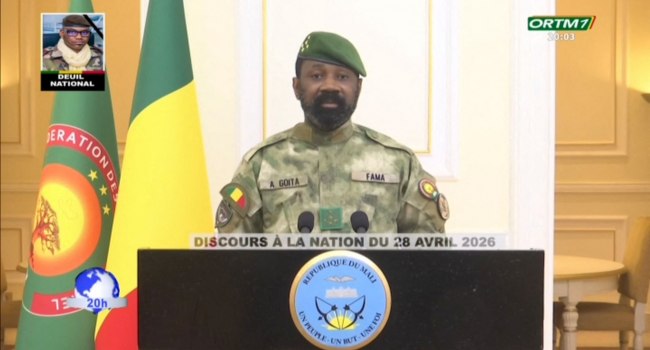
Mali’s army and its Russian mercenary allies surrendered a strategic northern military stronghold to armed rebels on Friday, as Tuareg separatists and jihadists wage a unified front to bring down the country’s junta.
The West African nation is facing a critical security situation following large-scale attacks last weekend on various junta positions by the Tuareg-dominated FLA and Al-Qaeda-linked JNIM groups.

During those assaults, the rebels killed Mali’s defence minister and took the crucial northern town of Kidal.
On Friday, forces from Mali’s key Tessalit “super-camp” near the Algerian border surrendered the military installation and scattered southward, an official from the FLA (the Azawad Liberation Front) told AFP.

The retreat comes one day after JNIM (the Group for the Support of Islam and Muslims) began a road blockade on the capital, Bamako. Only people already in the city were allowed to leave.
No clashes took place at Tessalit, a security source in Gao told AFP, adding that regular troops had already evacuated when the assailants entered.
A local elected official additionally confirmed to AFP that the Russians had abandoned their position there.
Tessalit serves as a strategic base due to its geographical location and features a well-maintained airstrip capable of accommodating helicopters and other large military aircraft.
It had hosted a significant number of Malian troops and their Russian allies, in addition to a substantial quantity of military equipment.
“Tessalit is the oldest base built by the colonial power (France)”, a military officer told AFP, adding that its position in the far north offered “a panoramic view of the entire Sahara”.
Mali forces were also forced to abandon a lesser military base, Aguelhok, located some 100 kilometres (60 miles) south of Tessalit, according to a local elected official and a separate FLA official Friday.
Earlier this week, a spokesman for the Tuareg rebels not only vowed that they will conquer the country’s north but predicted that the junta, which seized power in coups in 2020 and 2021, will “fall”.
Fierce Fighting
The coordinated attacks last weekend marked the largest assault in Mali in nearly 15 years.
The fierce fighting at various locations, including around Bamako, resulted in the death of at least 23 people and killed Defence Minister Sadio Camara, a key junta figure.
A government tribute was held Thursday for the 47-year-old minister, who died as a result of a car bomb at his residence in Kati, a garrison town near Bamako.
UNICEF said in a statement Friday that civilians and children had been killed and injured during the attacks, and that wounded children are being treated in local health facilities, without specifying the number.
A health centre in Gao was reportedly attacked, while a school in the Mopti region had been occupied by “weapon bearers”, with an explosive device located nearby, it added.
An investigation by the Bamako Military Prosecutor’s Office alleged that several active duty and former military personnel had been complicit in the “planning, coordination and execution” of the attacks.
It also alleged that exiled opposition politician Oumar Mariko had been involved, according to a document from the public prosecutor’s office Friday.
In recent years, Mali, like neighbouring junta-led Burkina Faso and Niger, has cut ties with colonial power France and moved closer to Moscow.
The three West African neighbours banded together to form the Alliance of Sahel States (AES), which created a joint force it says now numbers some 15,000 men.
The government of Niger said late on Thursday that the three countries had “conducted intense air campaigns” following the attacks in Mali last Saturday.
While that assault marked a turning point in JNIM’s fight against the Malian junta, it was far from the jihadists’ only campaign in recent times.
Late last year, JNIM attempted to cripple the Malian economy by imposing blockades on the supply of petrol and diesel being trucked in from abroad, particularly from Ivory Coast and Senegal.
AFP