

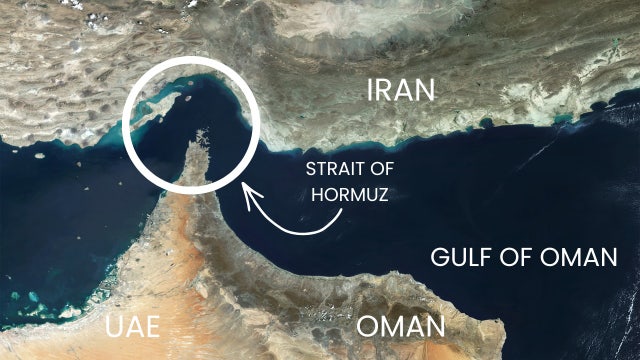
A South Korean ship was hit by an explosion in the Strait of Hormuz on Monday and Iranian drones caused a fire at a UAE oil port, as Tehran demonstrated its grip on Middle East oil after U.S. President Donald Trump said his Navy would open the strait.
The U.S. military said two U.S. merchant ships had made it through the strait, without saying when. Iran denied any crossings had taken place, and there was no indication that Trump’s “Project Freedom” had led to a

Trump’s new mission, which he announced on social media overnight, was the first apparent attempt to use naval power to unblock the world’s most important energy shipping route, creating a showdown at sea with Iran, which says no ships may pass without its permission.
In the two months since the U.S. launched an air war against Iran alongside Israel, Tehran has largely blocked the strait to ships apart from its own, causing the biggest disruption to global energy supplies in history. Since last month, the United States has imposed a separate blockade of ships leaving or entering Iranian ports.

The warring sides issued contradictory statements on Monday about the initial impact of the new U.S. mission, and Reuters could not independently verify the full situation there.
But there was no immediate sign of any sudden surge of ships attempting to cross. And the explosion reported aboard the South Korean merchant ship HMM Namu in the strait was likely to persuade commercial shippers it was still unsafe.
The UAE, meanwhile, reported a fire at an oil installation in its port of Fujairah following an Iranian drone attack. Fujairah lies beyond the strait, making it one of the few export routes for Middle East oil that does require passing through it.
Revolutionary Guards Say no Transit took Place
In a post on X, U.S. Central Command said some of its Navy guided-missile destroyers were inside the Gulf supporting the operation, and that two U.S.-flagged merchant vessels had crossed the strait “and are safely headed on their journey”.
It did not identify either the warships or the merchant vessels or say when any of those crossings had taken place.
Iran’s Revolutionary Guards said no commercial vessels had crossed the strait in the past few hours, and that U.S. claims to the contrary were false.
Earlier, Iran said it had fired on a U.S. warship approaching the strait, forcing it to turn around. An initial Iranian report had said a U.S. warship was struck, but Washington denied this and Iranian officials later described the fire as warning shots.
South Korea’s Foreign Ministry said there was a fire and an explosion onboard the Namu, operated by South Korean shipper HMM (011200.KS). Yonhap news agency reported that the government was checking intelligence indicating the vessel may have been attacked.
There were no casualties reported, and authorities were investigating what caused the blaze that HMM said broke out in the engine room of the Panama-flagged cargo ship.
Shipping Industry awaits Clarity on Safety
Oil prices jumped after the reports of new confrontations in the Gulf, wavering between 2% and 5% higher in volatile trade.
Treasury Secretary Scott Bessent told Fox News that the U.S. had absolute control of the strait.
But the shipping industry remains to be convinced that the vital oil route, whose closure has damaged global business and trade, is safe to use, with little sign of progress towards a negotiated resolution of Washington’s conflict with Iran.
In his social media post announcing the new mission, Trump gave few details of what action the U.S. Navy would take to get ships through the strait, where they face potential mines as well as attack from Iranian small boats, missiles and drones.
“We have told these Countries that we will guide their Ships safely out of these restricted Waterways, so that they can freely and ably get on with their business,” Trump wrote.
In response, Iran’s unified command told commercial ships and oil tankers:
“We have repeatedly said the security of the Strait of Hormuz is in our hands and that the safe passage of vessels needs to be coordinated with the armed forces … We warn that any foreign armed forces, especially the aggressive U.S. Army, will be attacked if they intend to approach and enter the Strait of Hormuz.”
Hundreds of Merchant Ships Stuck in Gulf for Months
The Joint Maritime Information Center, led by U.S. maritime forces based in Bahrain, told operators in a note that the U.S. had “established an enhanced security area to support Strait of Hormuz transits”.
It advised vessels to use Omani waters on the west of the strait to avoid mines, urging them to “carefully review risk assessments and routing ahead of transit”.
Hundreds of commercial vessels and as many as 20,000 seafarers have been unable to transit the strait during the conflict, the International Maritime Organization says.
The container shipping group Hapag-Lloyd (HLAG.DE), said on Monday that it considered that transit through the strait was still not possible.
Shipping and oil executives have said they need an agreed and full end to hostilities, because military convoys alone are not enough to allow normal traffic to resume safely.
The United Arab Emirates on Monday accused Iran of attacking an empty crude oil tanker belonging to the Abu Dhabi state oil firm ADNOC with drones as it attempted to pass through the strait.
Iran reviews U.S. Response to Peace Proposal
The United States and Israel suspended their bombing campaign against Iran four weeks ago, and U.S. and Iranian officials held one round of face-to-face talks. But attempts to set up further meetings have failed.
Iranian state media said on Sunday that Washington had conveyed its response to a 14-point Iranian proposal via Pakistan, and that Tehran was now reviewing it. Neither side gave details.
A senior Iranian official has confirmed that Iran’s proposal envisages ending the war on all fronts – including Israel’s attacks on Lebanon – and resolving the shipping standoff first, while leaving talks on Iran’s nuclear programme for later.
Washington wants Tehran to give up its stockpile of more than 400 kg (900 pounds) of highly enriched uranium, which the United States says could power a bomb.
Iran says its nuclear programme is peaceful, although it is willing to discuss some curbs in return for the lifting of sanctions. It had accepted such curbs in a 2015 deal that Trump abandoned.
Reuters