

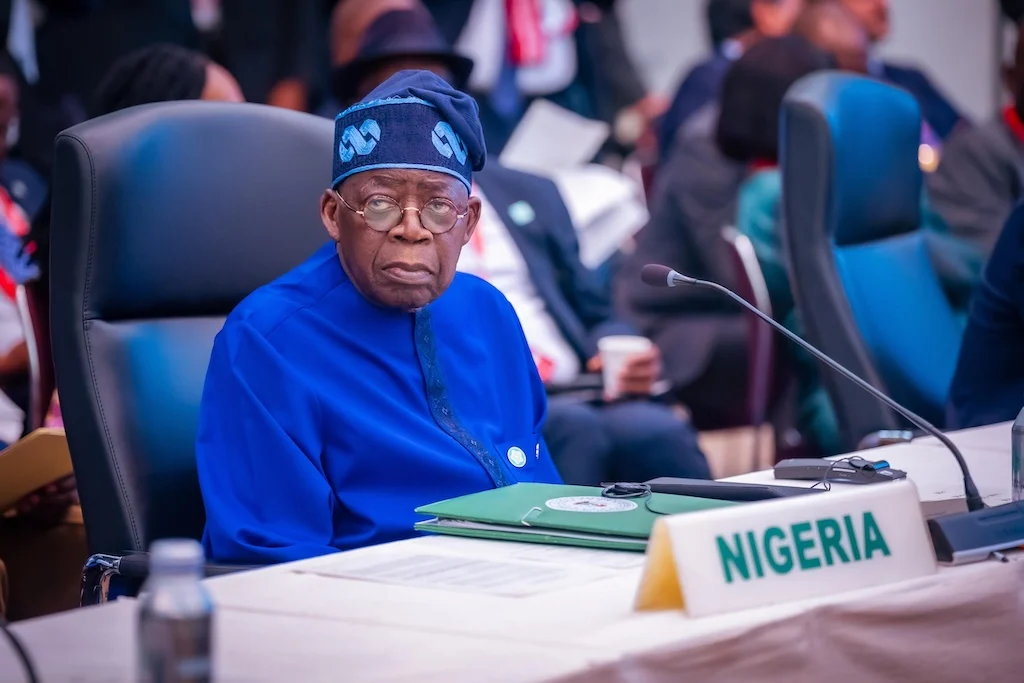
President Bola Tinubu has said that Nigeria will spend about US$11.6 billion on debt servicing in 2026.
According to a statement by presidential spokesperson, Bayo Onanuga, Tinubu made the remarks on Tuesday while leading Nigeria’s government, diplomatic, and business delegation to the Africa Forward Summit at the Kenyatta Convention Centre in Nairobi.
According to him, the debt to be repaid in the year is nearly half of the projected revenue.

“Every single dollar that leaves our treasury to pay punitive interest rates is a dollar that did not go into our steel sector, our textile mills, our agro-processing plants, or our digital industries. It is a dollar that did not train a young Nigerian engineer or provide affordable power for our factories. Our industrial base is being starved of the blood it needs — long-term, affordable finance — while creditors and rating agencies treat African sovereigns as permanent high-risk borrowers, regardless of our fiscal performance.
“So, I ask this gathering: how can an African manufacturer compete with a competitor in Europe, Asia, or North America when the cost of borrowing in our nations is five to ten times higher? How can we build cross-border industrial value chains under the African Continental Free Trade Area when our infrastructure projects face a financing gap deepened by the very institutions meant to bridge it? The answer is plain: we cannot. The international financial architecture, as currently constituted, is an instrument of industrial disarmament for Africa.

“Nigeria is not asking for charity. We are demanding a financial system that intentionally enables Africa to industrialise — to process its own minerals, refine its own crude oil, manufacture its own pharmaceuticals, and compete fairly in global markets. We will continue to borrow responsibly, but we insist that our creditworthiness be measured by our economic fundamentals and our industrial potential, not by outdated stereotypes,” he noted.
He called for deeper economic integration across Africa, stressing the need for policies that prioritise the continent’s industrial growth and prosperity.
Tinubu highlighted Nigeria’s blue economy potential as a key driver of Africa’s development, noting that it had long been underutilised due to insecurity and uncertainty.
“Today, I make an explicit commitment: Nigeria will intensify regional coordination by offering our Deep Blue Project’s maritime intelligence infrastructure as a shared data hub for willing Gulf of Guinea states. Interoperable systems, harmonised laws, and seamless joint enforcement must become the daily reality, not an aspiration on paper.
“Let no one misunderstand: maritime sovereignty does not repel investment — it attracts it. Secure sea lanes, predictable regulation, and functional courts are the preconditions that unlock private capital. Governance has de-risked Nigeria’s maritime proposition. We now invite partners to build on these gains as we advance climate-aligned port modernisation and the digital transformation of our maritime sector.
“As we endorse the Nairobi Declaration, Nigeria affirms that maritime sovereignty and ocean governance are the non-negotiable foundations of Africa’s Blue Economy transformation. We will continue to earn that sovereignty — through institutions, through assets, through law, and through iron-clad regional solidarity that turns our waters from a theatre of risk into a story of shared resilience.
“The oceans have no duplicate as a common heritage of mankind. For Africa, moving from sea blindness to ocean sovereignty is not a choice — it is a generational duty. Nigeria is ready, and we invite all present to join us in that duty,” the President stated.
Call For Global Financial Reform
Tinubu also addressed the need for reforms in the international financial system, insisting that Africa must not remain locked into raw-material exports while importing finished goods.
“Last September, from the podium of the United Nations General Assembly, Nigeria warned that the international system must reform or risk irrelevance. We spoke not only of the Security Council but of the financial and trade structures that quietly de-industrialise our nations. The evidence is before us. Despite decades of independence, Africa’s share of global manufacturing value added remains below 2 per cent.
“We export raw minerals, crude oil, and agricultural commodities, and we import processed goods at a premium. This pattern is not an accident. It is the product of a global financial architecture that starves our industries of affordable capital, tolerates massive illicit financial flows, and imposes policy constraints that our competitors themselves never observed when they built their own industrial bases.
“Nigeria does not come to this discussion as a supplicant. We come as a nation that has taken painful, homegrown decisions to put our house in order — removing fuel subsidies, unifying our exchange rate, recapitalising our banking system with over US$3.4 billion, and exiting the FATF grey list. These reforms were sovereign choices, not external conditions. They have delivered a declining debt-to-GDP ratio, now projected at 32.3 per cent in 2026, stronger external reserves of $45.5 billion, and a return of investor confidence. But, Excellencies, even a reforming nation like Nigeria is being forced to de-industrialise by a financial system that is stacked against us,” he noted.
Migration And Development
On migration, Tinubu said addressing root causes was essential, stressing that people would not risk dangerous journeys if opportunities existed at home.
He said Nigeria had embedded migration management within its broader economic reforms, including subsidy removal, banking recapitalisation, and agricultural modernisation.
He also called on international partners to increase investments in climate adaptation, energy access, digital skills, and job-creating sectors, urging that a portion of Official Development Assistance (ODA) be directed toward reducing irregular migration pressures.
Regional And Global Cooperation
Tinubu also called for stronger African cooperation in shaping global migration governance, saying existing frameworks such as the Global Compact for Safe, Orderly and Regular Migration remained insufficient due to their non-binding nature.
He expressed support for African Union initiatives, including the Migration Policy Framework and the Khartoum Process, while urging stronger links between regional and global systems.
The Africa Forward Summit, co-hosted by Presidents Emmanuel Macron and William Ruto, brought together leaders and officials from over 30 countries.
Opening statements were delivered by Macron, Ruto, UN Secretary-General António Guterres, and African Union Commission Chair Mahamoud Ali Youssouf.
On the sidelines, Tinubu met Madagascar’s President, Michael Randrianirina, and held talks with CAF President Patrice Motsepe, where he reaffirmed Nigeria’s readiness to host the 2026 CAF Awards.
He was accompanied by senior government officials, including ministers of foreign affairs, finance, agriculture, marine and blue economy, environment, industry, communications, as well as leading private sector figures such as Aliko Dangote, Tony Elumelu, Abdulsamad Rabiu, and Aigboje Aig-Imoukhuede.
The summit featured discussions on investment, AI, digitalisation, agriculture, creative industries, climate change, and strategies to translate policy discussions into industrial development across Africa.