

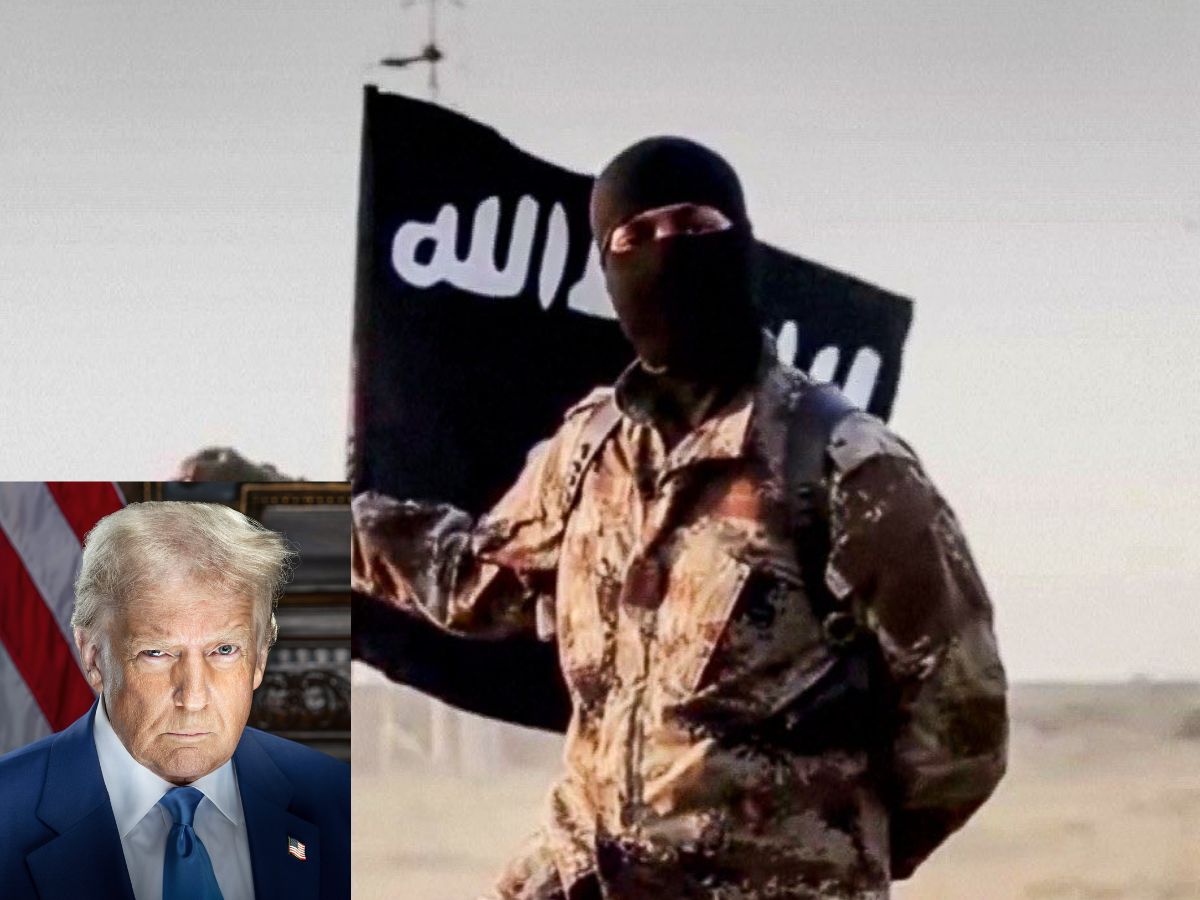
US President, Donald Trump announced on Friday that American forces, working together with the Nigerian military, had successfully killed Abu-Bilal al-Minuki, a senior ISIS leader described as the group’s global second-in-command. According to Trump, the operation took place in Nigeria and was carried out jointly by the United States and Nigerian armed forces through what he described as a highly coordinated mission.
“Tonight, at my direction, brave American forces and the Armed Forces of Nigeria flawlessly executed a meticulously planned and very complex mission to eliminate the most active terrorist in the world from the battlefield. Abu-Bilal al-Minuki, second in command of ISIS globally, thought he could hide in Africa, but little did he know we had sources who kept us informed on what he was doing,” Trump wrote on Truth Social.

Trump praised the success of the mission and claimed that the removal of Al-Minuki would significantly weaken ISIS operations across different regions.
“He will no longer terrorize the people of Africa, or help plan operations to target Americans. With his removal, ISIS’s global operation is greatly diminished. Thank you to the Government of Nigeria for your partnership on this operation. GOD BLESS AMERICA!” Trump added. The US President also thanked the Nigerian government for cooperating in the counterterrorism mission.

Who Was Abu-Bilal al-Minuki?
Islamic State operative Abu-Bilal al-Minuki was believed to be one of the highest-ranking members of the terror group globally. Reports suggest he was also known by the name Abu Bakr ibn Muhammad ibn Ali al-Mainuki.
According to the Counter Extremism Project, Al-Minuki mainly operated in the Sahel region of Africa, a vast semi-arid zone stretching nearly 5,900 kilometres across the continent from the Atlantic Ocean to the Red Sea.
The Sahel region covers several African countries, including Senegal, Mauritania, Mali, Burkina Faso, Niger, Nigeria, Chad, and Sudan, while also extending into Gambia, Guinea, Cameroon, and Eritrea.
Abu-Bilal al-Minuki’s Role in ISIS
Reports indicate that Al-Minuki served as a senior commander within the Islamic State West Africa Province (ISWAP). He was also responsible for directing operations linked to the Lake Chad division under ISIS’s General Directorate of Provinces.
Authorities believed he played an important role in coordinating international funding, communication, and strategic guidance for extremist networks operating in Africa.
Due to his alleged involvement in global terror activities, the US State Department officially designated Al-Minuki as a Specially Designated Global Terrorist (SDGT) in June 2023.
The operation marks another major counterterrorism action involving US and African security forces as concerns continue over ISIS-linked activities across parts of the Sahel and West Africa.
The Man Who Brought ISIS’s New War Doctrine to West Africa
Security and intelligence sources familiar with extremist operations in the Lake Chad Basin say al-Manuki arrived in the region alongside nearly 60 foreign fighters dispatched to strengthen ISWAP’s operational structure and battlefield capabilities.
These foreign operatives, many believed to possess combat experience from the Middle East and other jihadist theatres, reportedly introduced a new phase of insurgent warfare into Nigeria’s conflict environment.
Their arrival coincided with noticeable tactical changes in ISWAP operations, including: increased night assaults on military formations, coordinated raids using mobile attack teams, deployment of armed drones for surveillance and attacks, more sophisticated use of improvised explosive devices (IEDs), renewed suicide bombing campaigns, and improved battlefield communication and logistics coordination.
Before this evolution, many insurgent attacks in the North-East were largely localized and predictable in pattern. But over time, ISWAP began displaying tactics associated with ISIS operations in Iraq and Syria particularly the use of surprise night attacks designed to overwhelm isolated military positions before reinforcements could arrive.
The emergence of armed drones in the conflict was especially alarming for Nigerian security planners. Though relatively crude in deployment, the adaptation reflected an insurgent force learning, evolving and absorbing global jihadist warfare methods.
It was believe al-Manuki was central to that transformation. His role reportedly extended beyond battlefield command. He allegedly coordinated international funding channels, strategic communications, training support and doctrinal guidance between ISIS central leadership and ISWAP factions operating across West Africa.
Why His Killing Matters
The killing of such a figure by U.S. and Nigerian forces carries three major implications. First, it disrupts ISWAP’s command and coordination architecture. Groups like ISWAP survive not merely because of fighters in the field, but because of the strategic networks behind them logistics, recruitment, financing, propaganda and external support systems. Removing a senior coordinator can create confusion, mistrust and operational paralysis within militant ranks.
The operation reflects a major intelligence breakthrough. For years, ISWAP’s greatest strength has been its ability to hide within difficult terrain stretching from the Lake Chad islands to the Sambisa forests and the wider Sahel corridor. Successfully locating and eliminating someone of al-Minuki’s profile suggests deep intelligence penetration into networks once considered highly secure.
President Trump himself referenced intelligence “sources” that monitored the ISIS commander’s activities. That statement alone will likely trigger internal suspicion within ISWAP circles, where fears of infiltration and betrayal can become deeply destabilising.
The operation signals growing international concern over the expansion of ISIS-linked activities in West Africa.
The Sahel has increasingly emerged as one of the world’s most active jihadist theatres following instability in Mali, Burkina Faso and Niger. Western governments now see the region not merely as a local African security issue, but as a transnational threat capable of projecting violence beyond the continent.
With Agency reports