

By Kio Amachree
On the first of August 2026, the Independent National Electoral Commission did something quietly devastating. In compliance with Section 29(3) of the Electoral Act, it published the personal particulars of the candidates for the 2027 presidential election. Among them was Form EC9 of the incumbent President of the Federal Republic of Nigeria, Bola Ahmed Tinubu.
Look at what INEC published. Look carefully, because the document speaks for itself.
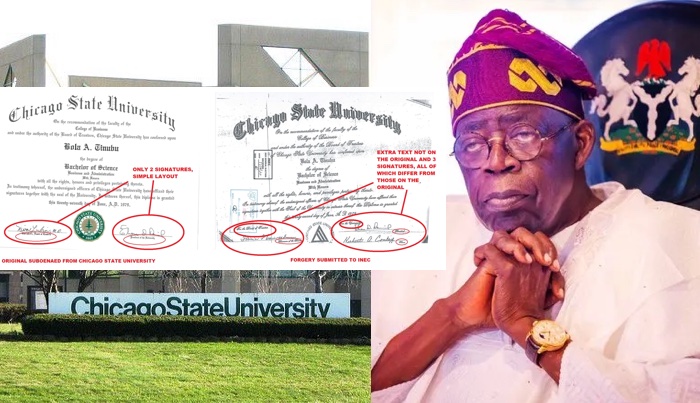
Under Schools Attended and Educational Qualifications, the spaces for primary school and secondary school are blank. Not redacted. Not disputed. Blank. A man asking to lead 250 million people for a second term cannot, or will not, tell his own electoral commission where he learned to read. The only entry is a Bachelor of Science said to have been obtained in 1979, supported by a certificate so faint and illegible in the published copy that Nigerians on social media have spent the weekend squinting at it in disbelief. This is the same Chicago State University credential that was the subject of sworn depositions and litigation in the United States before the 2023 election.

Now let us do what too few commentators bother to do. Let us read the law of the land.
Section 131(d) of the 1999 Constitution provides that a person shall be qualified for election to the office of President if he has been educated up to at least School Certificate level or its equivalent. Section 318(1) defines that phrase: a Secondary School Certificate or its equivalent, or Grade II Teacher’s Certificate, or the City and Guilds Certificate; or education up to Secondary School Certificate level; or a Primary Six School Leaving Certificate combined with ten years of acceptable service, approved training, and demonstrated literacy in English to INEC’s satisfaction.
In other words, the Constitution asks for the most modest educational proof imaginable. A primary school leaving certificate would do. And yet the President of Nigeria has now, for the second consecutive election cycle, submitted a form in which the primary and secondary education fields are empty. The bar is on the floor, and he declines even to step over it in writing.
Then there is the oath. Form EC9 is not a questionnaire. Its full title is Affidavit in Support of Personal Particulars. It is sworn testimony, deposed before a commissioner for oaths. Section 29(4) of the Electoral Act entitles any Nigerian to obtain and scrutinise it. Section 29(6) provides that where a court determines that information in that affidavit is false as it relates to the constitutional requirements of eligibility, the court shall disqualify the candidate and the sponsoring political party. That is the law. Not my opinion. The law.
And the National Youth Service Corps. The NYSC Act makes service compulsory for Nigerian graduates. The certificate now published shows service in Oyo State from December 1982 to November 1983, for a degree said to have been earned in 1979, by a man born, on his own account, in 1952. Nigerians are entitled to ask how these dates fit together with a work history that begins at Mobil in 1983, and they are entitled to a coherent answer rather than abuse.
Which brings us to the work history. On this new form, the President lists exactly one private employer in his entire life before politics: Mobil Nigeria Limited, 1983 to 1992, reason for leaving, advancement. Gone entirely is Deloitte, the American firm where he once told an interviewer he had accumulated 1.8 million dollars in salaries and bonuses. Why gone? Because when the investigative journalist David Hundeyin subpoenaed Deloitte in 2022, the firm could produce no record of any such employment. The claim simply evaporated from the official biography, the way inconvenient chapters of this presidency always evaporate. And behind all of it sits the certified United States court record of the 1993 forfeiture of 460,000 dollars in proceedings connected to a narcotics trafficking investigation, a matter Nigerians were told to forget, but which the world has not forgotten.
I must be honest with my readers, as I always am. In 2023 the Presidential Election Petition Tribunal and the Supreme Court upheld Mr Tinubu’s qualification, and the Electoral Act as drafted allows only an aspirant from the same party primaries to sue over a false affidavit. The courts have spoken, and I do not pretend otherwise. But the courts answered a narrow legal question. They did not answer the moral one, and they cannot compel a nation’s respect.
So I ask my fellow Nigerians, at home and across the diaspora, the question the blank spaces ask: what does it say about us that we accept this? Every teacher applying to a local government job in Nigeria must produce her First School Leaving Certificate. Every corporal in the Nigerian Army must document his secondary education. Every young graduate must serve his NYSC year and present his discharge certificate to get an entry-level position. Yet the highest office in the land is held by a man whose published record begins, miraculously, at university, whose degree certificate cannot be clearly read, whose claimed employers deny him, and whose sworn forms grow thinner with each election.
INEC has done its statutory duty by publishing. Now it must do its constitutional one: scrutinise. The APC must explain why it has again sponsored a candidate who will not complete the simplest sections of a sworn form. The National Assembly must amend Section 29(5) so that any registered voter, not merely a rival aspirant, has standing to test a presidential affidavit in court. And every Nigerian of conscience must keep asking, loudly and lawfully, until the blank spaces are filled.
A nation that demands honesty from its schoolchildren cannot excuse dishonesty at the very top. The documents are public now. Read them. Share them. And do not look away.
Enough is enough.
Kio Amachree writes from Stockholm.