

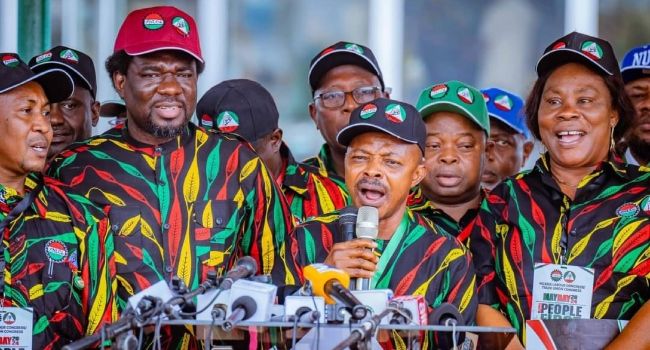
Labour leaders have called for an urgent review of Nigeria’s ₦70,000 national minimum wage, saying the current wage no longer reflects the economic realities facing workers amid rising inflation and the cost of living.
The call was made at the 2026 Nigeria Rights of Workers Summit in Birnin Kebbi, Kebbi State, organised to commemorate 88 years of legally recognised trade unionism in Nigeria.

The summit, themed “The Rights of Workers: Decent Work and a Just Economy in Nigeria,” brought together labour leaders, policymakers, workers, employers, civil society organisations and representatives of the National Industrial Court.
Speaking on behalf of the President of the Nigeria Labour Congress, Joe Ajaero, the NLC Deputy President, Amba, identified the minimum wage as one of the major issues confronting Nigerian workers.

He said the ₦70,000 minimum wage had become inadequate in the face of the increasing cost of goods and services and called for fresh negotiations with the Federal and State Governments.
“The current ₦70,000 minimum wage can no longer adequately respond to the realities confronting Nigerian workers, particularly with the rising cost of living.”
According to him, the expiration of the existing wage arrangement makes renewed discussions necessary to establish a wage that better reflects prevailing economic conditions.
Former President of the Nigeria Labour Congress, Ayuba Wabba, said the welfare of workers should not be viewed solely through the size of their pay packets.
He argued that decent work must also guarantee workers’ rights, social protection and meaningful engagement between labour, employers and government.
“Decent work is not only about wages. It is also about workers’ rights, social protection and meaningful social dialogue between workers, employers and government.”
The Convener of the summit and Executive Director of Call a Lawyer, Ekpa Stanley, said the 88th anniversary of trade unionism provided an opportunity to assess the progress made by Nigerian workers and identify areas requiring urgent attention.
He said the objective should be to ensure that the principles of decent work translate into tangible improvements in workers’ lives.
Meanwhile, Kebbi State Governor, Nasir Idris, assured workers that the state government would implement any new national minimum wage agreed upon at the federal level.
“Whatever is agreed upon at the national level on the minimum wage, Kebbi State will implement,” the governor said.
Idris also pledged to advocate for improved wages during discussions at the Nigeria Governors’ Forum, while commending civil servants for their contributions to governance and national development.
The summit also examined other challenges confronting workers, including workplace safety, discrimination, inflation and the protection of casual and other non-traditional workers.
As Nigeria marks 88 years of legally recognised trade unionism, labour leaders say the anniversary should serve as a renewed call for policies that guarantee fair compensation and better working conditions for workers.
They maintained that without a wage structure that keeps pace with economic realities, the gains of decades of workers’ organisation and collective bargaining risk being undermined.