

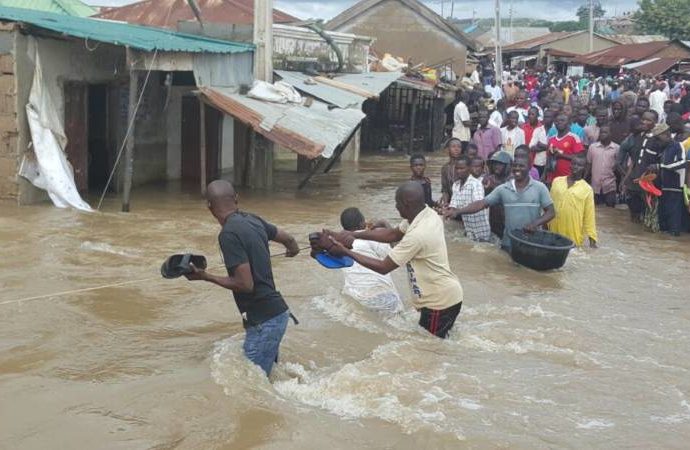
Thirty states and over one hundred local government areas in the country have been designated ”high-risk flood areas” by the federal government with a warning that residents in such areas should expect more rains and flooding in the days and months ahead.
Nigeria’s minister of water resources Suleiman Adamu made the declaration on Wednesday in Abuja while addressing newsmen.

According to Adamu, the delay in commencement of the rains, the monsoon wind, and the rising sea levels are factors that will further increase floods in states like Lagos, Rivers and Cross River, among others.
“In the coastal areas, including Lagos, Port Harcourt and Calabar, possible coastal flooding in these places were mentioned in the NlHSA’s flood outlook. However, the case of Lagos State is unique, because it is very low-lying and there is reclamation of wetlands, which ordinarily should be buffers for floods,” the minister said.

“In addition, the rapid urbanisation of the Lagos coastal areas has not been matched with robust drainage provisions as well as adequate seawalls/barriers along the sea stretch.
“It is also important to mention that the monsoon wind (a strong prevailing wind that brings rain), which usually arrives the West African coast around June 22 to September/October, brings in a lot of rain to the land, coupled with the sea rise due to the melting of the glacier in the polar region.
“All these are definitely increasing the amount of water in the low-lying coastal areas of Lagos State. Worthy of note is the fact that the rains did not start early this year, thereby possibly causing long duration torrential downpour and causing unexpected urban/flash floods in areas with non-existing or inadequate drainage systems in the country.”
“People must not use this facility as refuse bins, which will block and render the facility useless with the probability of flooding heightened when it rains,” he said.
“Furthermore, people in the riverine areas must not erect residential structures on the flood plains as these areas are an extension of the river space. Unfortunately, people have refused to yield to advice.
“It is therefore suggested that state and local governments should do more to enforce environmental laws/town planning guidelines so as to check such uncontrolled physical development activities.”