

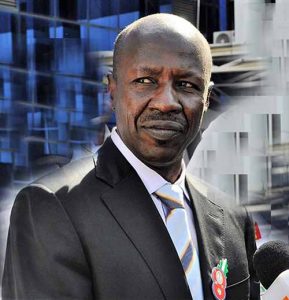
The lingering face off between the Presidency and the Senate over the confirmation of Ibrahim Magu, the Acting Chairman of the Economic and Financial Crime Commission (EFCC) may soon become subject to litigation at the Supreme court as the Presidency has been advised by a team of legal experts to approach the apex court for the interpretation of section 171 of the Constitution.
A source in the Presidency informed newsmen Sunday evening that the legal experts advising the presidency on the matter unearthed a ruling of the Supreme Court where the Chief Justice of the Nigeria (CJN), before his elevation as CJN, had ruled in line with the view of the Presidency on the matter.

Justice Onnoghen was quoted to have ruled, ”in the case of Chief Isaac Egbuchu V. Continental Merchant Bank Plc & Ors (Supra), at page 19, paragraph C that ‘the time-honoured principle of law is that wherever and whenever the Constitution speaks, any provision of an act/statute on the same subject matter must remain silent.’
The legal experts according to the Presidential source has therefore asked the Presidency to await a judicial pronouncement on Section 171.

The source said: “In fact, the conclusion of the legal advisory on the matter is very clear that a judicial pronouncement preferably by the Supreme Court is what will settle the matter.”
“The divergent positions being held by the Executive and the Legislature on the subject of confirmation …is one that requires timely and ultimate resolution.
“Such resolution could only be reached through judicial process…Such interpretation would lay to rest the lingering crises between the two arms.”
Concerning the issue of the Acting EFCC Chairman, the legal experts concluded that “the rumblings in the discourse on the confirmation of the EFCC Chairman have more to do with politics than with the law.
“It is trite that, by the rule of ejusdem generis, any office to which Section 171 or other Sections of the Constitution do not confer on the Senate the power of confirmation of appointment to such office cannot be imported and accorded equal footing as the mentioned offices.”
The experts also drew the attention of the Presidency to a case, “in the recent past, the ministerial nomination of late Prof. Abraham Babalola Borishade (Ekiti State) by President Olusegun Obasanjo was rejected repeatedly by the Senate.”
“In fact, it would be recalled that this particular nomination was presented four times in 18 months before it was eventually confirmed by the Senate.
“This position is because of the long established and entrenched principle of law that any legislation that is inconsistent with the provision of the Constitution is null and void and of no effect whatsoever to the extent of such inconsistency. (See the Supreme Court cases of DR. OLUBUKOLA ABUBAKAR SARAKI v. FEDERAL REPUBLIC OF NIGERIA (2016) LPELR-40013 (SC).