

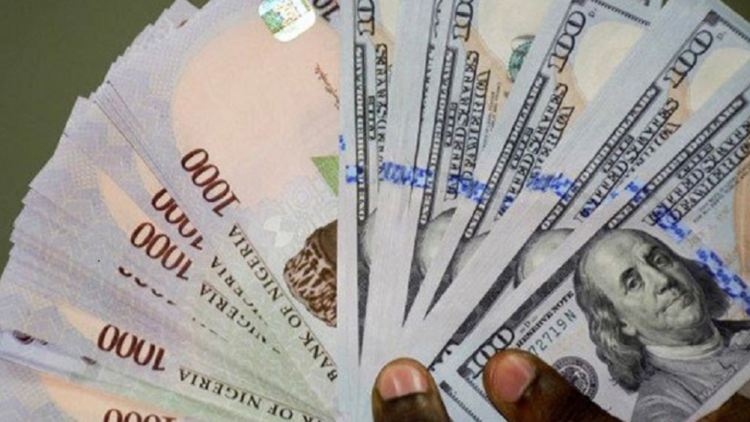
Our reporter/ There are strong indications that the Tinubu government is mulling a policy that will result in the conversion of foreign currencies in domiciliary accounts of citizens to naira to stabilise the national currency, which currently is on a free fall.

According to Punch report, if the government goes ahead with the plan, it will order the conversion of foreign currencies sitting idly in individuals’ and corporate organisations’ domiciliary accounts to naira at a rate to be determined by the Central Bank of Nigeria.
Top Presidency sources told the publication that the move is meant to stabilise the naira, which recorded its biggest fall in the official Nigerian Foreign Exchange Market on Monday, depreciating by 24 per cent to close at N1,348 per dollar.
They further told the publication that the problem of forex scarcity and the naira fall was an elite issue, adding that the Federal Government would not fold its arms and continue to watch some individuals hoarding foreign currencies at the expense of the naira.
“The problem of dollar scarcity is an elite problem. You will notice that this happens at the end and the beginning of a new month. That is when the exchange rate goes up. Invariably, that is when governors collect FAAC (Federal Account Allocation Committee) allocations. Whatever the connection, we don’t know, the source said.
“There is no country in the world where people open domiciliary accounts to keep dollars. It happens only in Nigeria. This must be addressed. This is not only a political issue, but it is also an economic issue that must be addressed. Genuine demands driven by economic activities can’t bring this huge pressure. By June, dollar demands are supposed to have gone down when Dangote Refinery must have started.
“Nobody should keep a domiciliary account if they do not have legitimate foreign currency earnings like salary or getting foreign exchange revenue, either as an individual or as a company. Even if you have foreign exchange inflow as a result of your work, immediately after the money lands in your account, the banks should automatically change it to the local currency and your local currency account will be credited with the equivalent value.
“In Nigeria today, there are over $30bn in domiciliary accounts of individuals. It is in the CBN account. The records are there. It is not right. These are issues we will have to deal with. In other countries, dollars are not meant to stay in peoples’ accounts.”
The Tinubu administration in September 2023 said it was looking to attract funds held in domiciliary accounts and those held by Nigerians abroad into massive investments in various sectors of the economy.
The Minister of Finance and Coordinating Minister of the Economy, Wale Edun, had at a press briefing said Nigerians have huge funds in domiciliary accounts and hold large sums abroad, which can be deployed to rejuvenate the economy, adding that his team was working to provide the needed environment to attract such funds into the local economy.
“What we can see is that really, there are quite substantial sources of foreign exchange in Nigeria.
“There is a lot of cash outside the system, which if brought into the system, increases the money supply of dollars, increases in reserves and so forth, Edu said then.
“There are funds in domiciliary accounts, which if you give people the incentives they will utilise for investment in Nigeria.
“Nigerians in Nigeria have huge holdings of foreign currencies in banks and financial institutions abroad.
“We need to provide the environment that brings those funds home to choose to invest in the Nigerian economy rather than foreign economies, which is what they are doing right now…
“There is plenty of hope and it is our determination to put in place the kind of structures and incentive framework that brings Nigeria money abroad and even Nigeria money outside the system into the financial and economic system to work, to create jobs for Nigerians.”
With Punch report
Leave a Reply