

Nigeria’s Central Bank Governor, Godwin Emefiele has warned that the Peoples Democratic Party (PDP) presidential candidate’s suggestion that the exchange rate should be free float is a recipe for disaster.

“The MPC reviewed it and concluded that it would be wrong. It is as good as saying that we should go back to the era of Structural Adjustment Programme (SAP) in Nigeria,” Emefiele said.
The implication can better be imagined. It will certainly lead to capital flight, lead to massive depreciation or devaluation of the currency and ultimately to currency crisis in Nigeria and I think we should all know that it is a road to perdition to ever go in that direction.”
Addressing reporters at the end of the bi-monthly Monetary Policy Committee (MPC) meeting, the first for the year, Emefiele added: “There is no capital control in Nigeria today because you cannot find the CBN trying to intervene in the market for demand and supply of foreign exchange.”
“Normally, the Central Bank as an independent institution is apolitical but it is also important that at the MPC meeting today we asked ourselves if there is any merit in it to begin to say that we should look at free-floating the currency or that we should allow free import of goods that we have restricted. The MPC came to a conclusion that this was a wrong premise. We cannot be talking about allowing import of items that can be produced in the country today, exporting jobs from Nigeria to foreign countries, and we say we have the interest of Nigeria at heart? We don’t agree with anybody. It is a wrong premise to say that you will allow imports to just flood the country just because you want to please anybody. It is not in our interest. We will remain apolitical. We will not want anybody to drag the central bank into issues that are within our remit otherwise, we would respond to it.”
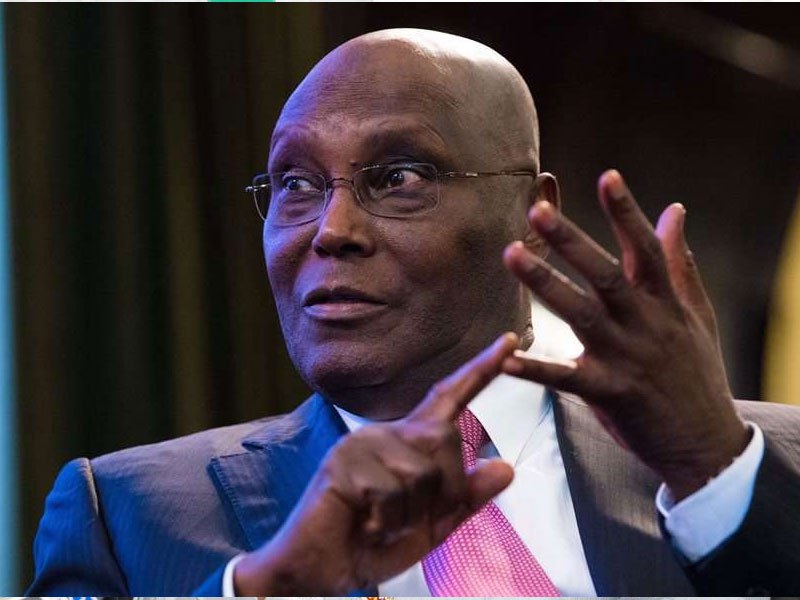
Alhaji Atiku Abubakar in his policy document condemns what he calls the “Poor exchange rate management”, which bred “multiple exchange rates that were exploited by opportunists, rent-seekers, middlemen, arbitrageurs, and fraudsters”. By imolication, he wants the naira to be on a free-float, the CBN governor said.
In his assessment of the economy so far, Emefiele said: “It is important for me to say that if we think about where we are coming from, I would say I like to use some numbers: for instance, in September 2008, Nigeria’s reserve was about $62 billion, GDP was growing 7.2%; inflation was 15%. By January 2014, GDP was 6.2%, inflation had trended downwards to 8% and external reserve was 40%. Let us not forget that we were in a period of prosperity, in terms of crude prices between 2009 and 2014 which is five straight years, with no shut-ins in pipelines, with high crude oil price, reserve still dropped. From the end of 2014, we started another round of global crises. The global crises resulted in stagflation in Nigeria. GDP dropped, to 2.79% in 2015, went further and contracted to negative of 1.58% in 2016, improved in 2017 and then we are hopeful that 2018 would end at about 1.8%.
“Inflation was 15% in 2008, dropped to 8% in 2014 and it moved up to about 9.5% and by January 2017, it had moved up to 18.7% but today, through the activities of monetary and fiscal authorities, inflation had gone down to 11.4%. He also stated that “by 2008, with higher reserves, with higher productivity reserves dropped to $40 billion in January 2014 anmd ended 2014 at $35 billion, went further down in 2015 to $28 billion and indeed by October 2016 as a result of economic crises, reserves had plummeted further to $23 billion. Today as a result of all the actions and activities of both the monetary and fiscal authorities supported by the government, reserve is up, went to $39 billion in 2017 and 2018 we closed at $42.5 and I said so in my communique that even as at now, as a result of the confidence in the management of the Nigerian foreign exchange, the confidence in the management of the country, we’ve seen confidence even in foreign investors returning, reserves as at yesterday was $43.28 billion.”
“We have seen FX stability in the market and as if all of you will recall, that sometime in 2016 and up to early 2017, we saw a situation where exchange rate even in the black market had moved up in February to N525/$ and I was being told that by March, it will hit N1000/$. But as a result of the actions of CBN today, the all markets in fact BDC has come down to about N360/$ and even slightly lower. The I&E Window, which is a market that we set up as a free in-free-out market today is about N362/$. So we have seen a substantial convergence in the foreign exchange market in Nigeria.” On balance of trade developments, the CBN governor noted that “when people say nothing has happened in the economy, they should know that it is not a fair comment to make both on government and also on the monetary authority. In 2008, imports stood at $86 billion. By 2017, it had dropped to $45.8 billion as a result of the activities of government and of monetary and fiscal authorities.”
“Trade balance in 2008 was $46.2 billion, went down during the period of global crises to $6.4 billion and today it is up. In 2017 it was $13.15 billion and closed at $18.7 billion in 2018. When you talk about activities that related to issues on the restriction of foreign exchange for the importation of certain food items you will also find for instance that rice which is a major staple in Nigeria: data from the Thai Rice Exporters Association says that in 2014, Nigeria imported 1.2 million metric tonnes of rice. In 2015, it had dropped to 644 metric tons. In 2016 to 58,000 metric tons. In 2017, to 23,000 metric tons and 2018 to 6,000 metric tons” he pointed out. While reading the communique, Emefiele lamented that “on external borrowing, committee noted the increase in debt levels, advising for caution, noting that it could fast be approaching the pre-2005 Paris Club exit levels. MPC also noted that although there was an increase in inflation rate for the second consecutive month based on month on month, inflation continued to moderate indicating that the year on year measures will also moderate in the near term.”
With NAN report