

Several African states have imposed far-reaching restrictions in a bid to curb the spread of coronavirus.

South Africa has declared a national disaster and announced a ban on travel from the worst-affected countries, while Kenya has also imposed sweeping travel restrictions.
The measures are an attempt to prevent a major outbreak on a continent with poor health services.
At least 27 African states have so far been affected by the virus.
Benin, Liberia, Somalia, and Tanzania are the latest African countries to report cases.
Morocco has shut public baths, known as hammams, cafes, restaurants, cinemas, and mosques after reporting 28 cases and one fatality since the outbreak of the global pandemic.
In total, nearly 350 people have been diagnosed with the virus across Africa. Seven people have died while 42 have recovered, the World Health Organization (WHO) said.
Most of the cases involve people arriving from Europe and North America.
South Africa has imposed the most severe restrictions on its citizens since the end of white-minority rule after reporting its first local transmission, increasing the number of cases to 62.
In an address to the nation on Sunday, President Cyril Ramaphosa declared a national disaster.
“Initially, it was people who had travelled out of the country, especially from Italy, who had positively tested for the virus,” he said.
“It is concerning that we are now dealing with internal transmission of the virus,” Mr. Ramaphosa said.
Mr. Ramaphosa said he would chair a government command council that would “coordinate all aspects of our extraordinary emergency response”.
Among the measures he announced are:
–The closure of nearly half – 35 out of 72 – of South Africa’s land border crossings from Monday, along with two of its eight sea ports
-Banning foreign nationals from eight countries – including the UK and US – from entering South Africa from Wednesday
-Advising people to avoid domestic travel
–Shutting all schools with immediate effect until the end of the Easter holidays
– Banning all public gatherings of more than 100 with immediate effect. This would affect the biggest annual event in South Africa – an Easter religious service attended by several million followers of the Zion Christian Church at its headquarters in northern Limpopo province.
In an address to the nation, President Uhuru Kenyatta announced:
A ban on travel from any country that is known to have the virus
Any Kenyan or foreigner residing in Kenya would have to go into quarantine if they arrive from an affected country
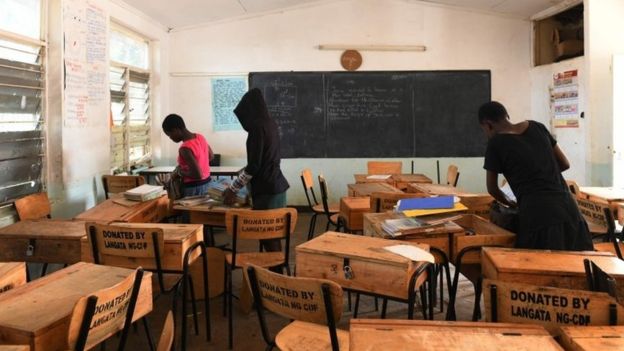
The closure of all education institutions.
But Kenya’s efforts to tackle the global pandemic have been hampered by nurses who have started a go-slow at a coronavirus isolation ward at the Mbagathi Hospital in the capital, Nairobi.
The nurses say there is a shortage of protective gear and they have not received adequate training on how to deal with patients.
The hospital has admitted 22 people who came into contact with the first confirmed case in Kenya.
What’s happening in other African countries?
Other African states that have announced measures to curb the spread of the virus include:
–Ethiopia – the closure of all schools and a ban on all public gatherings and sporting activities
– Ghana – a ban on all public gatherings and travel from countries with more than 200 cases of coronavirus. As a result, all football matches in the country have been suspended.
-Tunisia – the closure of all borders and the suspension of prayers in mosques
–Algeria – a ban on all travel to and from Europe
–Mozambique – a ban on all gatherings of more than 300 people
-Morocco and Djibouti – the suspension of all international flights.
–Senegal has shut down all schools and bans large religious gatherings with more than 24 people affected.
Photo: AFP
With BBC report
Leave a Reply