

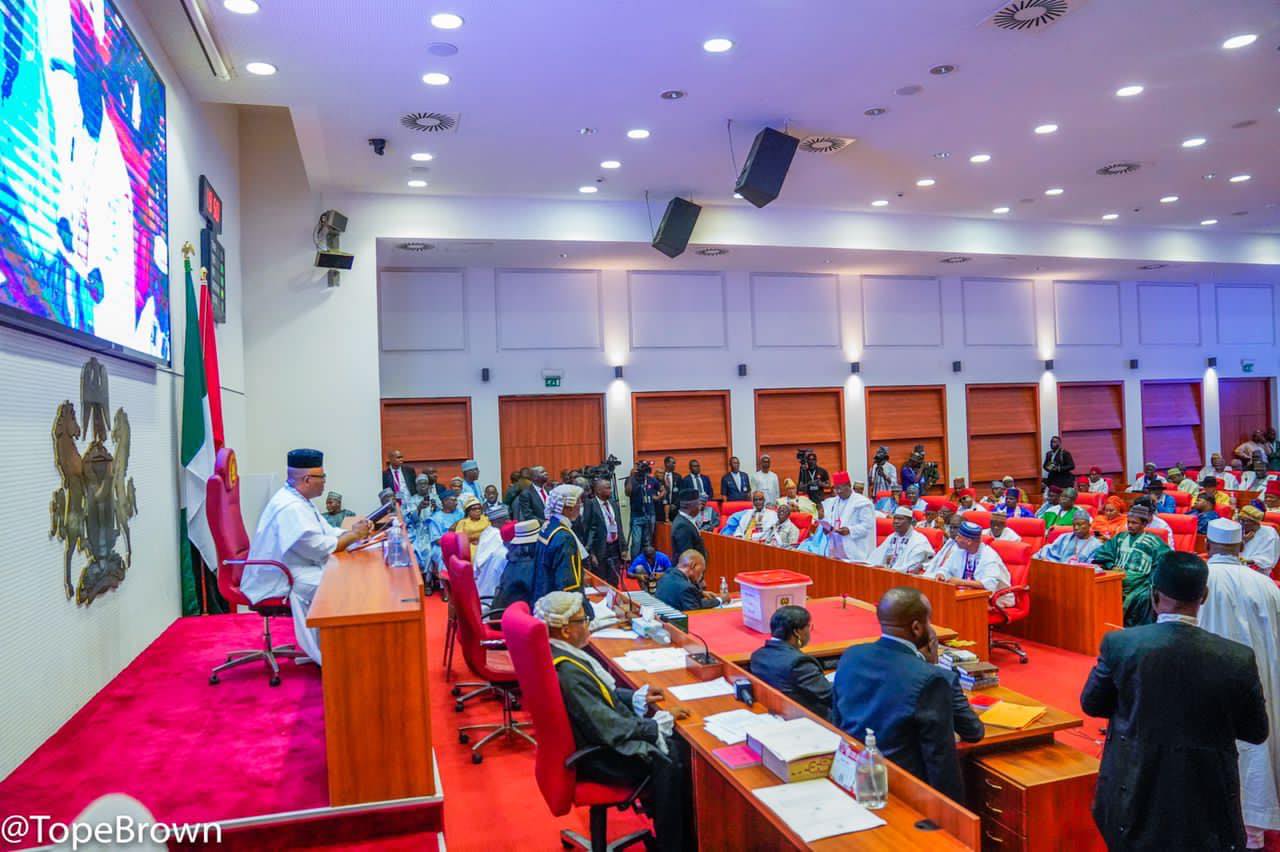
The APC led national assembly on Tuesday against vocal protest by opposition lawmakers and Nigerians forcibly passed the Electoral Act amendment bill with manual collation of results as backup.

Below is the step by step guide on how the ruining party orchestrated what many has described as the equivalent of a civilian coup on democracy…
1. A joint committee was to meet 11am on 16th February to review, harmonize the electoral bill, but no-one showed up. Only opposition lawmakers. Instead..
2. At midnight APC, PDP lawmakers secretly convened outside the NASS complex at the Senate President’s lodge in Matiama, to ‘align’ ahead of the emergency plenary session that had been set for today, Tuesday 17 February 2026.
3. The committee that was set up last week to reconcile 20 clauses, including the “e-transmission” issue in clause 60 and clause 84., Did infact NOT meet at all until today.
4. Reps, Senate had no idea what they’d be passing or voting on today. Knowing this, Deputy Speaker Benjamin Kalu decided to breeze through the 156 clauses 10 by 10, without reading out to the house.
5. “Clause 1-10” approved. “Clause 10-20” approved. “Clause 20-30” approved. Then the minority reps started protesting [the viral video] asking him to start again and read it out one by one, because they do not have a copy of what he was approving on their behalf.
6. Despite their protest, Kalu continued with a brief smirk. Up till Clause 65. Until Reps started walking out. Then he obliged and restarted from 1.
7. Reaching clause 60. Speaker Tajudeen Abbas called for a vote on mandatory e transmission or not. Despite the majority voting for mandatory, he smacked the gavel favoring the opposite.
8. In the Senate too, recall last week, Senator Abaribe asked for an open vote to be made on clause 60 (3) but being a minority it won’t have favoured him, so he withdrew. But senate rejected his withdrawal.
9. On Tuesday that method was used for transparency, since Abaribe wants to be seen on socaial media, according to Akpabio. As expected, those against real time transmission were 55. Those for, were just 15. — the Nays had it.
10.Despite a rowdy session, The National Assembly passed the Electoral Act, 2022 (Repeal and Re-Enactment) Bill 2026. President Tinubu is expected to sign it into law before end of March 2026.
11. In 2027, e-transmission will only be used, if there is no network problems. Otherwise, the traditional signed form EC8A will be used, and transported to the collation center. — Nigerian feel this will facilitate more rigging.
12.Election notice by INEC was reduced to 300 days from 360 days, to avoid election dates clashing with Ramadan. This makes INEC flexible and capable to move elections dates to April, instead of February.
13.On primaries, under section 84. Indirect and Consensus primaries have been abolished, leaving only direct primaries. Meaning that, delegates can no longer vote & party members can no longer unanimously pick a candidate. Instead, every registered party member will vote for a flagbearer.
14.FRAUD, the minority lawmakers called it. Arguing that, parties should be allowed to decide how to select their flagbearer.
15.The Minority lawmakers walked out and reiterated that APC members voted against mandatory transmission of results, not on grounds of patriotism but because of political interests and affiliations.
Leave a Reply