

Ebun Francis|

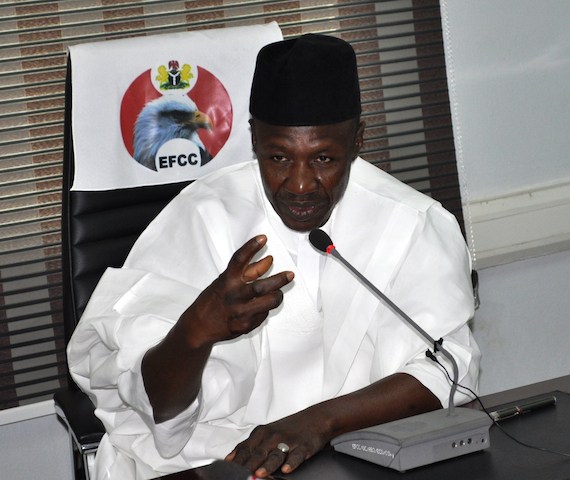
Ibrahim Magu, the Acting Chairman of the Economic and Financial Crimes Commission on Monday claimed that 32 individuals and corporate organizations in the country looted over N1.3 trillion during the time of former president Goodluck Jonathan between 2011 and 2015.
Magu who disclosed this in his keynote address at the opening ceremony of the 2019 First Batch Conversion Training Programme to Procurement Cadre for Federal Parastatals and Agencies, organised by the Bureau of Public Procurement, decried the huge financial loss to the country, blaming the poor state of the procurement process in Nigeria for corruption which he said had continued to thrive in government agencies and parastatals.
Magu said, “One third of this money (#1.3trn), using World Bank rates and cost, could have comfortably been used to construct well over 500km of roads; build close to 200 schools; educate about 4000 children from primary to tertiary levels at N25million per child; build 20,000 units of two-bedroom houses across the country and do even more.
“The cost of this grand theft, therefore, is that these roads, schools and houses will never be built and these children will never have access to quality education because a few rapacious individuals had cornered for themselves what would have helped secure the lives of the future generations, thereby depriving them of quality education and healthcare, among others.”
The acting EFCC chairman further noted that the training organised by the BPP was aimed at giving the participants the tools, knowledge and understanding they would need to carry out their duties in their respective places of primary assignments in an efficient and transparent manner.
He continued,“I sincerely hope that at the end of this training, we will see a few cases of financial propriety in our procurement processes in government agencies and parastatal; Indeed, corruption could kill Nigeria, if we do not scale up our proficiency in contract and procurement management process.”
According to Magu, the establishment of the EFCC in 2003 was borne out of the determination of the Federal Government to combat fraudulent activities of some Nigerians and foreigners, mismanagement in the economic sector, corruption by public officials and lack of accountability and transparency in government dealings.
He identified some of the fraudulent practices in procurement processes to include kickbacks, conflict of interests, fraud in the bidding process, bid suppression, collusive bidding, bid rotation and market division.
Others, according to him are co-mingling of contracts, change order abuse, cost mischarging, defective pricing, false statement and claim, phantom vendors, product substitution, unnecessary purchases and purchases for personal use or resale.
Leave a Reply