

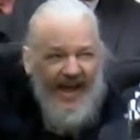
WikiLeaks founder Julian Assange was arrested by British police and carried out of the Ecuadorean embassy on Thursday after his South American hosts abruptly revoked his seven-year asylum, paving the way for his possible extradition to the United States.

An agitated, frail-looking Assange with white hair and a white beard was carried out of the embassy by at least seven men to a waiting police van.
“Julian Assange, 47, has today, Thursday 11 April, been arrested by officers from the Metropolitan Police Service (MPS) at the Embassy of Ecuador,” British police said.
Police said they arrested Assange after being invited into the embassy following the Ecuadorean government’s withdrawal of asylum. Police later added that Assange had been arrested a second time after an extradition request from the United States.
An agitated, frail-looking Assange with white hair and a white beard was carried out of the embassy by at least seven men to a waiting police van.
“Julian Assange, 47, has today, Thursday 11 April, been arrested by officers from the Metropolitan Police Service (MPS) at the Embassy of Ecuador,” British police said.
Police said they arrested Assange after being invited into the embassy following the Ecuadorean government’s withdrawal of asylum. Police later added that Assange had been arrested a second time after an extradition request from the United States.
The arrests, after nearly seven years holed up in a few cramped rooms at the embassy, mark one of the most peculiar turns in a tumultuous life that has transformed the Australian programmer into a rebel wanted by the United States.
Assange’s supporters said Ecuador had betrayed him at the behest of Washington, that the termination of his asylum was illegal and that they feared he would ultimately end up on trial in the United States.
To some, Assange is a hero for exposing what supporters cast as abuse of power by modern states and for championing free speech. But to others, he is a dangerous rebel who has undermined U.S. security.
WikiLeaks angered Washington by publishing hundreds of thousands of secret U.S. diplomatic cables that laid bare often highly critical U.S. appraisals of world leaders, from Russian President Vladimir Putin to members of the Saudi royal family.
Assange made international headlines in early 2010 when WikiLeaks published a classified U.S. military video showing a 2007 attack by Apache helicopters in Baghdad that killed a dozen people, including two Reuters news staff.
It was not immediately clear what specifically prompted Ecuador to end Assange’s stay in the embassy, or the extent of the diplomacy that led to the arrest. The Kremlin said it hoped his rights would not be violated.
Assange in June 2012 took refuge in Ecuador’s London embassy, behind the luxury department store Harrods, to avoid being extradited to Sweden, where authorities wanted to question him as part of a sexual assault investigation.
Sweden dropped that investigation in 2017, but Assange was arrested on Thursday for breaking the rules of his original bail in London.
Friends of Assange said the solitude he had experienced in the embassy had hurt him most.
“It was a miserable existence and I could see it was a strain on him, but a strain he managed rather well,” said Vaughan Smith, a friend who visited Assange. “The thing that was most difficult for Julian was the solitude.”
“He was very tough, but the last year in particular was very difficult. He was constantly being surveilled and spied upon. There was no privacy for him.”
WikiLeaks said Ecuador had illegally terminated his political asylum in violation of international law.
Assange’s relationship with his hosts collapsed after Ecuador accused him of leaking information about President Lenin Moreno’s personal life.
Moreno said Assange’s diplomatic asylum status had been canceled for repeated violation of conventions. He said he had asked Britain to guarantee that Assange would not be extradited to any country where he might face torture or the death penalty.
“The British government has confirmed it in writing,” Moreno said. “The asylum of Mr Assange is unsustainable and no longer viable.”
Reuters
Leave a Reply