

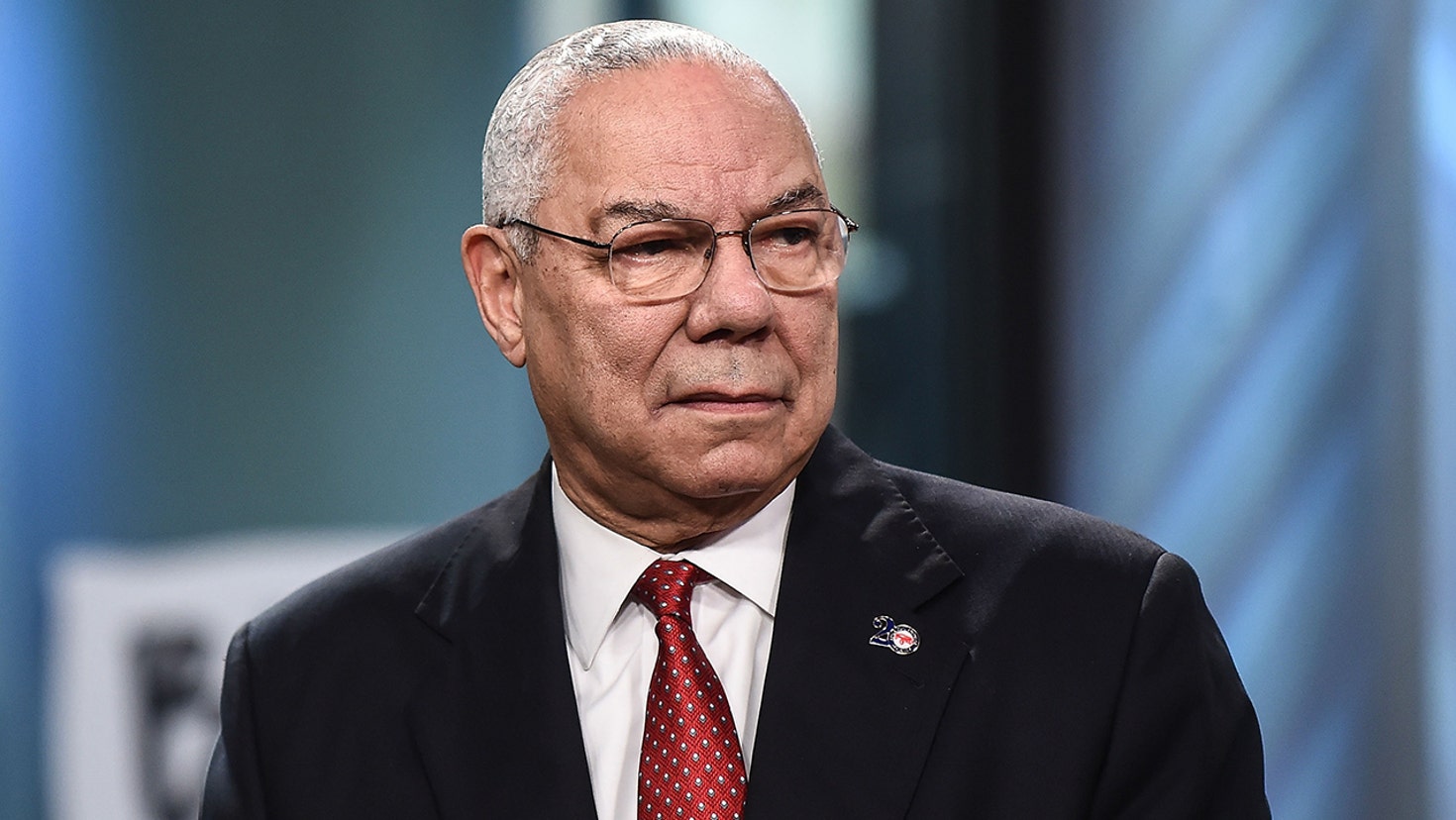
Gen. Colin Powell, the influential former secretary of state and chairman of the Joint Chiefs of Staff who played a pivotal policy role during the administration of then-President George W. Bush, died Monday at 84 from complications related to COVID-19, his family announced.

“We have lost a remarkable and loving husband, father, grandfather and a great American,” his family said in a statement, adding that he was fully vaccinated.
The statement continued, “We want to thank the medical staff at Walter Reed National Medical Center for their caring treatment.”
Powell, the first Black secretary of state, served in Bush’s Cabinet from 2001-2005, including during the tumultuous years following the Sept. 11 terrorist attacks. The State Department described Powell, a Republican, as being “one of the foremost supporters” of taking “swift military action” against al Qaeda. Powell demanded “immediate” cooperation from Afghanistan and Pakistan in the U.S. effort to hunt down those responsible for the attacks.
By 2003, when the Bush administration’s focus had expanded to Iraq, Powell pushed for United Nations inspectors to investigate the claims that Saddam Hussein was manufacturing weapons of mass destruction. Powell presented intelligence to the U.N. in February 2003 that supported the administration’s claim that Iraq did have weapons of mass destruction and had the capabilities of producing more. In 2004, though, the State Department said some of the intelligence he presented was “found to be erroneous.” Powell, though, according to the State Department, felt military action should not begin “until a large coalition of allies and a long-term occupation plan were in place.” Despite his advice, the administration moved toward preemptive military action against Iraq.
While the majority of his term as secretary of state was focused on Afghanistan and Iraq, the State Department said Powell pursued other areas of U.S. foreign policy—including strengthening bilateral relationships with Russia and China—including his efforts to manage the U.S. withdrawal from the U.S.-Russian Anti-Ballistic Missile treaty, and the signing of the Moscow Treaty on Strategic Offensive Reductions in May 2002.
Powell also pushed for international cooperation for North Korea and Iran to halt their nuclear weapons program. Under his leadership, the Bush administration also achieved nonproliferation success in Libya, when it agreed to give up its nuclear weapons program in 2003, according to the State Department.
Powell, during his time at the State Department, also pushed the Bush administration to increase its commitment to the international fight against AIDS, and helped to secure additional funding.
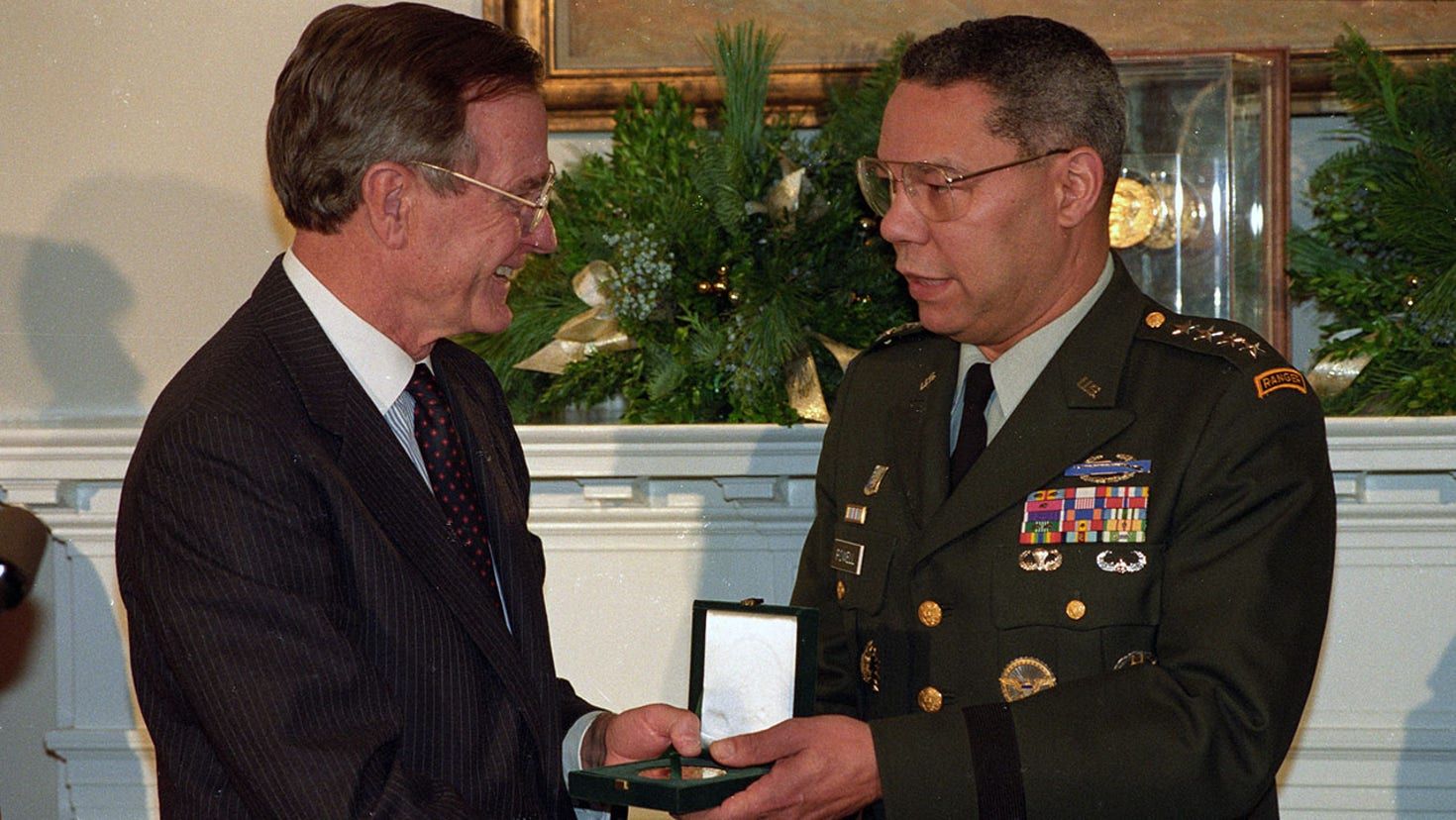
President Bush presenting Joint Chiefs of Staff Chairman Gen. Colin Powell with a Congressional Gold Medal at the White House in 1992. (REUTERS/Gary Cameron, File)
Powell was born on April 5, 1937 in Harlem, N.Y. His parents were Jamaican immigrants and raised him in the South Bronx.
He attended City College in New York, where he began his military service by joining the Reserve Officer Training Corps (ROTC). Powell graduated at the top of his class with the rank of cadet colonel–the highest ranking in the corps.
He served for 35 years in the military–beginning as a second lieutenant in the U.S. Army. Powell was one of the 16,000 military advisors dispatched to South Vietnam by then-President John F. Kennedy in 1962.
He was awarded the Purple Heart, and later that year, the Bronze Star. Powell served a second tour of duty in Vietnam in 1968 to 1969. He was injured in a helicopter crash. Despite his own injuries, he managed to rescue his fellow soldiers from a burning helicopter and was awarded the Soldier’s Medal.
In total he received 11 military decorations, including the Legion of Merit.
Powell’s career in politics began during the Nixon Administration, when he worked in the White House Office of Management and Budget. He received his MBA from George Washington University.
Powell, though, went back to military service as a battalion commander in Korea, and was promoted brigadier general, commanding a brigade of the 101st Airborne Division.
In the administration of former President Jimmy Carter, Powell was an assistant to the Deputy Secretary of Defense, and to the Secretary of Energy. He was promoted to major general
In 1987, then-President Ronald Reagan appointed Powell to serve as National Security Adviser–a position he held until 1989.
Powell was appointed as Chairman of the Joint Chiefs of Staff on Oct. 1, 1989 by then-President George H.W. Bush, and served in the role until Sept. 30, 1993. Powell was the first Black chairman of the Joint Chiefs of Staff, and the youngest officer ever to hold the post. During his time in that post, Powell oversaw 28 crises, according to the State Department, including Operation Desert Storm in 1991.
Powell stepped down from the post in 1993 and founded America’s Promise Alliance, an organization aimed to help at-risk children, before incoming President George W. Bush nominated him for secretary of state in December 2000.
Foxnews report
Leave a Reply