

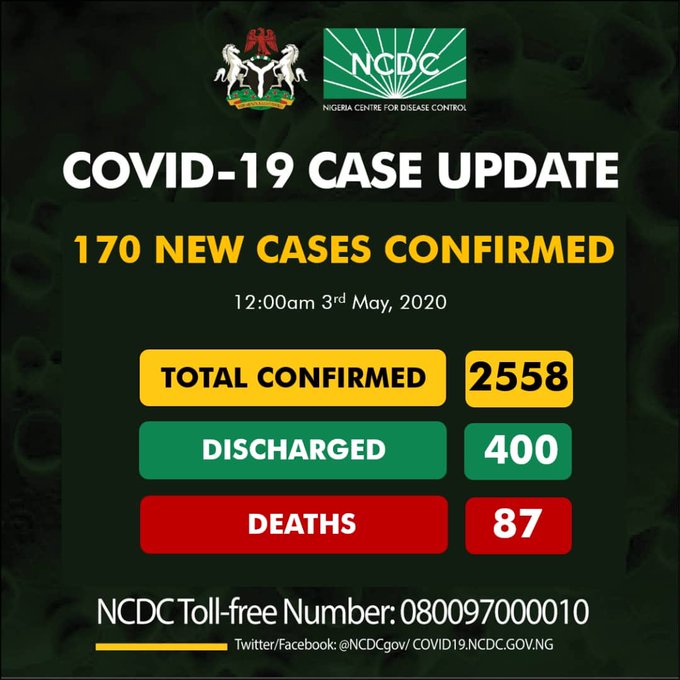
Chidi Samuel| Nigeria on Sunday night confirmed 170 new coronavirus cases bringing the county’s toll 2558.

The Nigeria Centre for disease Control made the disclosure via its Twitter handle@NCDCgov.
Accordig to the health agency, the new infections were recorded in Lagos, Kano, Ogun, Bauchi, Kaduna, FCT, Sokoto, Katsina,Bornu, Nasarawa, Adamawaand Oyo.
The agency further stated that as at Sunday night, the country recorded 2558 confirmed cases of the virus, with 87 deaths and 400 persons discharged.
The tweet read, ”170 new cases of #COVID19;
39-Lagos
29-Kano
24-Ogun
18-Bauchi
15-Kaduna
12-FCT
12-Sokoto
8-Katsina
7-Borno
3-Nasarawa
2-Adamawa
1-Oyo
2558 confirmed cases of #COVID19 in Nigeria.”
Discharged: 400
Deaths: 87
-Scientists confirm you can’t catch virus twice
The good news, however, is that South Korean scientists have now concluded that Covid-19 patients cannot relapse after recovering from the disease – and blame faulty tests for second positives recorded in the country.
The Sun reports that this development will greatly reassure governments threatened by the prospect of a never-ending cycle of infection and reinfection.
According to South Korea’s central clinical committee for emerging disease control, positive test results on people who had tested negative were the result of “fragments” of the virus lingering in their bodies, but with no power to make them ill or to infect others.
A total of 277 patients appeared to have become reinfected with the illness – raising fears that mutations in the virus could prevent patients from developing immunity to it, which would complicate the task of finding a vaccine and eliminate the possibility of “herd immunity”.
Oh Myoung-don, the head of the committee, said that the later positive results were caused by shortcomings in the polymerase chain reaction (PCR) test that detects the virus’s genetic information, or RNA, in samples taken from patients.
The test is unable to differentiate between “live” RNA and harmless traces that can remain in the body of someone who has fully recovered.
The committee said in a statement: “RNA fragments still can exist in a cell even if the virus is inactivated.
“It is more likely that those who tested positive again picked up virus RNA that has already been inactivated.”
The conclusion is consistent with findings by the Korea Centres for Disease Control (KCDC) that seemingly “relapsed” patients were not infectious.
Oh said: “The respiratory epithelial cell has a half-life of up to three months, and RNA virus in the cell can be detected with PCR testing one to two months after the elimination of the cell.”
He also claimed that coronavirus cannot cause chronic illness by lingering inside the nucleus of human cells.
In this respect the virus that causes Covid-19 is different from the HIV and hepatitis B viruses, which can remain dormant and reactivated later.
South Korea reported no new cases of local infection yesterday, for the first time since February.
There were five new cases, all of them in patients who contracted the virus outside the country, taking the national total to 10,765 cases including 247 deaths.
South Korea’s “trace, test, treat” policy is being lauded as one of the world’s best approaches to tackling the virus.
Short-term immunity
Sir Patrick Vallance, the Government’s chief scientific adviser, and Prof Chris Whitty, Boris Johnson’s chief medical adviser, have previously sought to reassure the public about catching coronavirus twice.
They claimed those who have had the virus once will develop some immunity – and it is rare to get an infectious disease again.
Sir Vallance revealed some people do catch infectious diseases a second time, but that it is rare and he added that there was no evidence to suggest that it would occur with the coronavirus.
Leave a Reply