

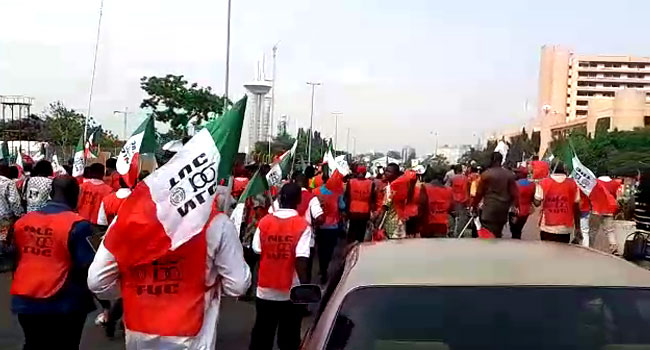
Labour unions have warned of a “shutdown” of the country should the governors insist a new minimum wage agreement approved by the federal government was not binding on the states.

Last week, the federal government agreed on how the wage increase will apply to different categories of workers. The pact came after weeks of talks and threats of a nationwide strike by workers.
But on Monday, Chairman of Nigeria Governors Forum (NGF) Governor Kayode Fayemi of Ekiti State, said the agreement between the federal government and organised labour on the consequential adjustments was not binding on state governments.
In a reaction, the organised labour said it will not accept any breach of the so-called consequential adjustment agreement, which details how the minimum wage of N30,000 will be implemented across various salary scales.
The group, however, said they were open to negotiations with the states, and would welcome implementation that takes into consideration how much the various states earn monthly.
Such talks mean states will first have to open their books and let Nigerians know how much they generate internally, officials of the organised labour told PREMIUM TIMES Tuesday.
The leader of the Joint National Public Service Negotiating Council, Simon Anchaver, said the minimum wage is a law that has been signed by the president.
“Since it is a law, the state government must pay, first and foremost, they should declare how much they are collecting from their respective state revenue then we will know if it is commensurable to pay minimum wage,” he said.
He said there could be “give and take” during such talks with the states once they disclose their revenues. Such negotiation should be supervised by federal officials.
He said labour unions will meet on November 5 and we will address the joint councils at the various state. “We will give them templates that will guide them on the implementation,” he said., warning that “We are ready for shutdown if any of the agreement is breached.”
The Nigerian Labour General Secretary, Emma Ugboaja, had earlier told Punch that no state could discard the fact that a minimum wage of N30,000 would be at the centre of every negotiation.
“Everybody will negotiate differently based on the state economy but what is sacrosanct is the minimum wage of N30,000 and how that will be adjusted across the board is the function of collective bargaining between the workforce and government,” he said.
NGF decision
Mr Fayemi said while the state governments have accepted the N30,000 baseline, each will negotiate with its workers on the implementation and the consequential adjustments.
Mr Fayemi assured that there would be consequential adjustments but that would be determined on a state by state basis.
Mr Fayemi said the agreement and directive between the government and labour leaders only apply only to federal workers.
“Every state has its own trade union, with a negotiating committee and they would undertake this discussion with their state governments. That is simply what we have said,” he said.
Long road
President Buhari signed the new minimum wage bill into law on April 18. But its implementation has been stalled over salary adjustments and disagreement between the labour unions and government representatives.
Specifically, the problem centred around the issue of relativity and consequential adjustments of salaries for various categories of workers.
The federal government then argued that the minimum wage was for junior-level workers ( levels 1 to 7) and that salary increase for other categories of worker would have to be negotiated.
On May 14, the federal government inaugurated the relativity and consequential adjustment committee, which set up a technical subcommittee to work out a template for the adjustment of salaries of public service employees in line with the minimum wage law.
The controversy was resolved between both parties on October 18, following which FEC approved the implementation.
The labour minister, Chris Ngige, announced details of the agreement to journalists.
“For COMESS wage structure, Grade level 7 gets 23 per cent, Salary grade level 8 gets 20 per cent, Salary grade level 9 gets 19 per cent, Salary grade level 10 -14 gets 16 per cent while Salary grade level 15-17 gets 14 per cent, ” he said.
”For those on the second category of wages structure, CONHES, CONRRISE, CONTISS etc, Level 7 gets 22.2 per cent, Level 8-14 gets 16 per cent, Level 15-17 gets 10.5 per cent, ” he added.
(PREMIUM TIMES)
Leave a Reply