

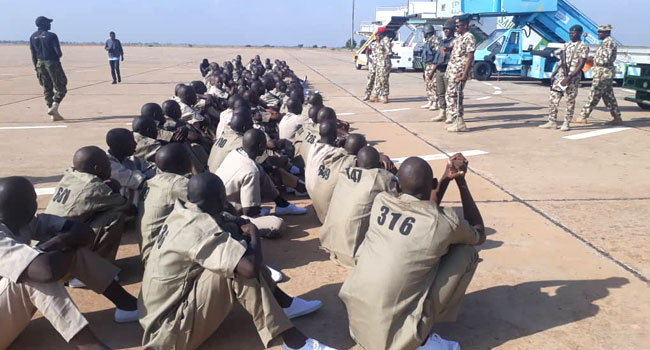
By our reporter| The chairman of the senate committee on army, Senator Ali Ndume (APC, Borno), on Wednesday once again kicked against the deradicalisation, rehabilitation, and reintegration of the repentant terrorists by the federal government.

Ndume is however, not alone in the fight against the policy as he has been joined by Internally Displaced Persons (IDPs) in Borno, Yobe and Adamawa states, elders and security experts, who kicked against the deradicalisation of Boko Haram members.
According to them, the exercise was premature considering that the Boko Haram war had not been won yet.
Ndume said, “I am in disagreement with the government on the issue of deradicalising and reintegrating (repentant Boko Haram members). I still maintain that. You can’t be resettling people, pampering them while the war is on.
“The committee is on the same page and I believe many Nigerians are on the same page with this. In my village, mallams that are Muslims, not ordinary Muslims but mallams, elders above 60, were taken to an abattoir and slaughtered by Boko Haram. 75 of them,” he said.
The Bornu lawmaker while commenting on the six Nigerians jailed in Dubai for funding Boko Haram, urged President Muhammadu Buhari to expedite action on the arrest and prosecution of Boko Haram sponsors.
Ndume said, ”those that were directly or indirectly involved in Boko Haram activities should be brought to book”.
“We are still calling on the Nigerian government to ensure that those that are directly or indirectly involved in Boko Haram activities should be brought to book and used as an example. I think we have not been up and doing on that.”
Dr Bulama Mali Gubio, who is the Secretary of the Borno Elders Forum on his part said, “Which communities are the insurgents going back to after undergoing the so-called deradicalisation exercise?
“After all these killings, displacing millions of dwellers of all those communities, destroying all the standing buildings – private and public in all those communities; and now, the perpetrators are said to be taken back; back to where?” he queried.
“Thousands of people – parents, spouses, children, siblings or cousin brothers and sisters were in one attack or the other killed by Boko Haram insurgents in Borno, while widows, and widowers, and orphans or other loved ones of those killed are still living in pain, and you are here empowering the killers.
“Take my case for instance – I, alone, have lost 17 people to the Boko Haram attacks; and one of my brothers whose five children were killed by Boko Haram insurgents also died as a result of the pain of losing his children.
“The responsibility of those left behind is on me. I think, there are hundreds of similar cases across the state and beyond.”
According to him, deradicalisation and reintegration of Boko Haram insurgents could not be possible without meeting, consulting, calming down the surviving loved ones of those killed, and then compensating them and seek their forgiveness and acceptance.
“If governments had done all these, it would have achieved its goals, but innocent people are being killed and nobody cares about the loved ones they left behind; and the killers are being empowered and released. Which kind of reconciliation process is this?
“A very powerful judicial commission of inquiry should have been set up to listen to those affected and/or offended by the insurgency so that they could express their feelings,” he said.
The deradicalisation exercise for members of the terror group, Boko Haram, is part of Nigeria’s Operation Safe Corridor aimed at facilitating the rehabilitation of ex-insurgents.
It was also part of the carrot and stick approach of the government towards ending the over 11- year Boko Haram insurgency that has claimed thousands of lives, displaced millions and destroyed their economy.
The initiative was first proposed at the Nigerian National Security Council (NSC) meeting in September 2015, after which repentant Boko Haram members were encouraged to surrender and embrace peace.
Leave a Reply