

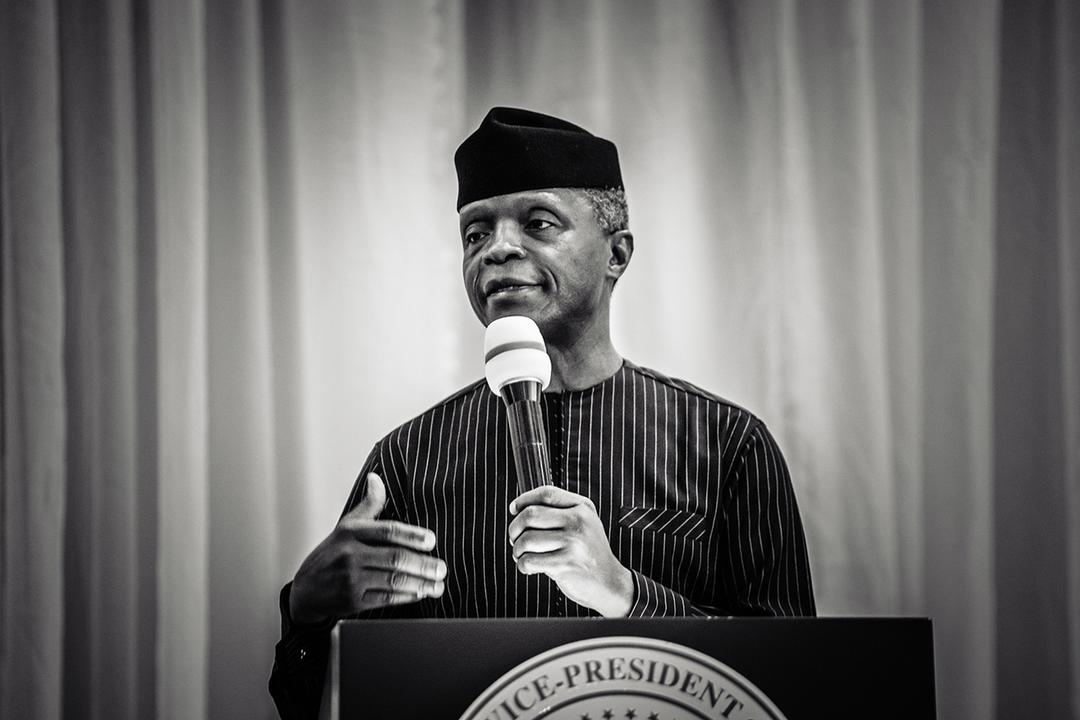
By our reporter| Nigeria is set to utilise its legal provisions that empower the Federal Government to collect taxes on profits made in the country by global technology and digital firms not based in the country, but with a significant economic presence here, Vice President Yemi Osinbajo has said.

Osinbajo made the disclosure on Friday, while interacting with a delegation of the Chartered Institute of Taxation of Nigeria (CITN), led by its President, Adesina Adedayo who visited him at the Presidential Villa.
While noting that the Federal Government will not be raising tax rates at this time, based on the Finance Act 2019, the Vice President said it is already empowered to widen the tax net, including through the collection of taxes on the Nigerian income of global tech giants with significant economic presence here, even if they have not established an office or permanent establishment and are currently not paying taxes in Nigeria.
In this regard, Section 4 of the Finance Act 2019, provides that “the Minister (Finance) may by order (of the President) determine what constitutes the significant economic presence of a company other than a Nigerian company,” the VP said.
“We have had severe economic downturns which of course implies that we may not be able to collect taxes with the aggressiveness that would ordinarily be expected, the vice president said.
“I think the most important thing is that we must widen our tax net so that more people who are eligible to pay tax are paying. Several efforts have been made, and I am sure you are aware of the initiatives including the Voluntary Assets and Income Declaration Scheme (VAIDS) which was also an attempt to bring more people into the tax net, including those who have foreign assets.”
“We have also recently taken a step with respect to a lot of the technology companies that are not represented here but who do huge volumes of business here.
“The Finance Act has shown that we are very prepared to ensure that these big technology companies do not escape without paying their fair share of taxation in Nigeria. Many of them do incredible volumes here in Nigeria and in several other parts of the region.
“We have drawn up the regulations and we are prepared to go, and I think that we are at least in a good place to tap into some of the tax resources we can get from some of these companies.”
In Nigeria, according to the Finance Act 2019, a company will pay taxes if it “transmits, emits or receives signals, sounds, messages, images or data of any kind by cable, radio, electromagnetic systems, or any other electronic or wireless apparatus to Nigeria in respect of any activity, including electronic commerce, application store, high-frequency trading, electronic data storage, online adverts, participative network platform, online payments and so on, to the extent that the company has significant economic presence in Nigeria and profit can be attributable to such activity.
Osinbajo further noted that while the Federal Government has no plans to raise taxes now, there are those who argue that “our tax rates are too low, comparing us to other places in the region where the rates are much higher.”
“So we have had to balance all of these issues because clearly, higher tax rates can be a disincentive to businesses and investments. In terms of domestic resource mobilization, we are trying to do the best we can, given the present circumstances and I believe that there is room for improvement,” he said.
Welcoming the delegation, the Vice President emphasized the need for regular interaction between the council and government to address issues bothering on tax legislation, noting that “there is need for continuous engagement with the National Assembly because engagement with government cannot be a one-off thing.”
Prof. Osinbajo added that the Federal Government has over the past few years, initiated programmes aimed at improving the growth of small businesses including the formalization of many of them. Under the Economic Sustainability Plan (ESP), there is a formalization of 250,000 businesses.
According to him, the ongoing MSME Week has encouraged many businesses to register with regulatory authorities in order for them to benefit from the numerous programmes earmarked by the government for their growth.
Leave a Reply