

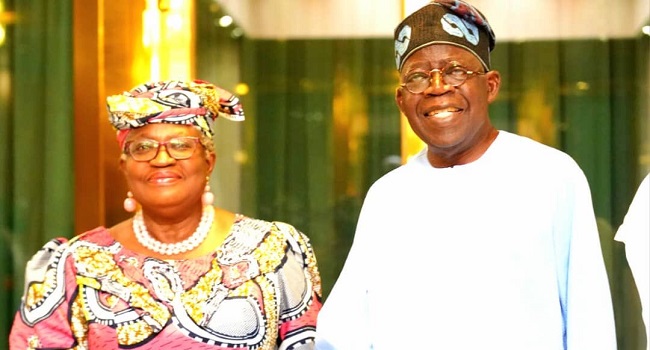
The director-general of the World Trade Organisation, Ngozi Okonjo-Iweala, has urged the Tinubu led government to be careful about borrowing and managing the country’s debt, saying economic reforms must improve the lives of ordinary Nigerians.
She also called on the government to sustain ongoing reforms while creating more jobs and economic opportunities for the country’s growing youth population.

Okonjo-Iweala, who spoke on Wednesday at the seventh Africa Emerging Markets Forum in Abuja, commended the Central Bank of Nigeria for its monetary and foreign exchange reforms,
She urged Nigeria to continue broader economic reforms while remaining disciplined in managing its finances.

“Nigeria needs to continue the work on overall macroeconomic reforms with a careful approach to fiscal issues, contracting of debt and debt management,” the WTO chief stated.
According to the latest data from the Debt Management Office, Nigeria’s total public debt stood at N159.28 trillion at the end of December 2025, rising by N14.61 trillion, or 10.10 per cent, from N144.67 trillion recorded at the end of 2024. The figure covers the debt owed by the federal government, the 36 states and the Federal Capital Territory. The government is also expected to continue borrowing this year to finance its 2026 budget deficit.
According to the WTO chief, the success of Nigeria’s reforms should not be measured only by improvements in economic indicators. Nigerians must, instead, begin to experience better living conditions through more jobs and opportunities.
“Above all, Nigeria needs to focus on creating jobs and economic opportunities for a young and hungry population. Nigerians have to feel the dividends of reform in the real economy,” noted the WTO chief.
Nigeria has one of the world’s youngest populations, with millions of young people joining the labour market every year. However, many struggle to find decent jobs, making employment one of the biggest economic challenges in the country.
Since President Bola Tinubu assumed office in May 2023, his administration has introduced major reforms, including the removal of petrol subsidy and the liberalisation of the foreign exchange market.
The policies have pushed up the cost of living, with many Nigerians facing higher prices for food, transport and other essentials.
For opportunities, Ms Okonjo-Iweala said countries that maintain stable economic policies and improve their business environment will be better placed to benefit from changes in global trade.
She noted that companies are increasingly looking for new places to invest and diversify their supply chains, creating opportunities for countries that can offer stability and predictable policies and urged Nigeria to continue strengthening its economy so it can attract long-term investment and create more jobs for its people.