

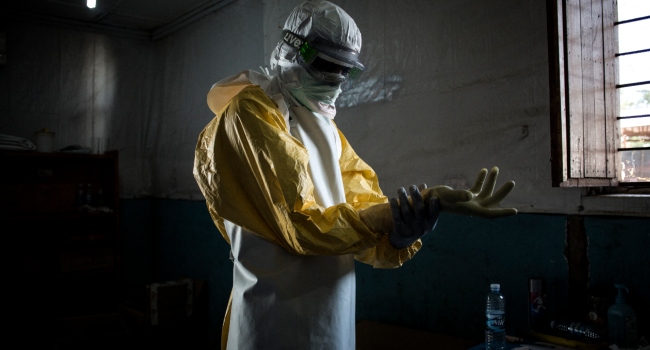
Nigeria faces a high risk of an Ebola outbreak due to the ongoing transmission of the disease in the Democratic Republic of Congo (DRC) and Uganda, as well as increased cross-border movement and international travel, The Nigeria Centre for Disease Control and Prevention (NCDC) has said.
Although no case has been confirmed in Nigeria, the agency said it has intensified preparedness measures amid growing concerns over the regional spread of the Ebola virus disease (EVD).
A statement issued on Sunday by Jide Idris, director-general of the NCDC, said the agency’s latest assessment showed that the likelihood of the virus being imported into Nigeria remains significant.
“This assessment estimated the risk of Ebola importation into Nigeria as high due to the ongoing transmission in the DRC and Uganda, international travel and population movement, uncertainty regarding the full magnitude of the outbreak, and the potential for delayed recognition because symptoms may overlap with endemic diseases such as malaria and Lassa fever,” the statement reads.

The NCDC said it has already identified states considered vulnerable because of their proximity to borders, busy transport routes and international entry points.
According to the agency, response activities are already ongoing in affected areas in the DRC and Uganda, including surveillance, contact tracing, infection prevention measures, laboratory testing and public awareness campaigns.
“However, we are aware of the ongoing Ebola outbreak in the Democratic Republic of the Congo (DRC) and recent reports of a confirmed imported case in Uganda linked to the outbreak in DRC,” the agency said.
NCDC said Nigeria’s national emergency operations centre (EOC) has been placed on alert mode, while the incident management system has also been activated to strengthen coordination and response mechanisms in the event of an outbreak.
The agency noted that the country still retains critical response capacity built from previous outbreaks, including trained rapid response teams, emergency operations centres and laboratory systems capable of handling viral haemorrhagic diseases.
“It also must be noted that Nigeria maintains important response capacities, including laboratory capability, trained rapid response teams, functional emergency operations centres (EOCs), established Viral haemorrhagic fever preparedness structures, and prior experience in successfully responding to Ebola and other viral haemorrhagic fever outbreaks,” the statement added.
“Epidemiologists and rapid response teams (RRTs) are also on alert for rapid deployment to any affected state, if required.”
The NCDC noted that laboratories in states with international points of entry would remain on standby, while sample collection and transportation systems are being strengthened to support rapid diagnosis of suspected cases.
The agency also said it had stepped up public communication efforts to counter misinformation and false claims surrounding the disease.
“NCDC is strengthening public awareness and risk communication activities, intensifying social listening and rumour management systems, and working with media organizations, healthcare professionals, community leaders, and digital platforms to amplify credible information and promote responsible public discourse,” the statement added.
“NCDC has also developed and disseminated Ebola Myths and Facts materials to address misinformation and false claims circulating online.”