

By Kio Amachree
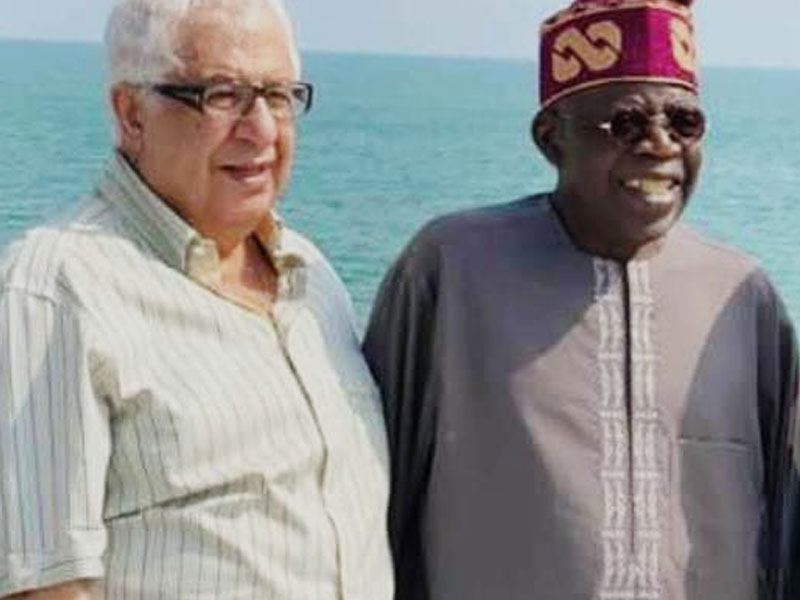
Gilbert Chagoury is not merely another businessman winning government work. He is one of the most powerful unelected figures surrounding Bola Tinubu—and his documented history should alarm every Nigerian.
The record is extraordinary.
In 2000, Chagoury was convicted in Switzerland of money laundering in connection with funds stolen under the dictatorship of General Sani Abacha. He paid a fine and returned approximately $66 million to Nigeria. Chagoury maintained that he did not know the money was stolen, and reports say the conviction was later expunged. But the historical fact remains: the man now enjoying privileged access to Nigeria’s presidency was convicted in proceedings arising from one of the greatest episodes of state looting in African history.

Then came the United States.
The US Department of Justice says Chagoury admitted arranging approximately $180,000 in illegal conduit contributions to four American political candidates between 2012 and 2016. As a foreign national, he was prohibited from financing US elections. Yet money was channelled through other people so that the donations appeared in their names.
Chagoury accepted responsibility, entered a deferred prosecution agreement, cooperated with investigators and paid $1.8 million to resolve the case. The investigation involved the FBI, the IRS Criminal Investigation division and the US Department of Transportation’s inspector general.
This was not gossip. It was an official American federal investigation into foreign money entering the US political system.
There is more.
A 2013 FBI intelligence report—explicitly described as based on unverified raw information—alleged that Chagoury had financed Lebanese politician Michel Aoun, who allegedly transferred money to Hezbollah. Chagoury categorically denied any connection to Hezbollah. He later reached a settlement with the US government confirming that he had never been placed on an American sanctions list, while the government acknowledged that unauthorised disclosures about him might have violated federal law and internal policies.
That qualification matters. An intelligence allegation is not a conviction, and it must never be presented as one.
But Nigerians are still entitled to ask why a man who attracted this degree of attention from American intelligence, immigration and law-enforcement agencies has been permitted to acquire such extraordinary influence over our national affairs.
Now place that history beside Tinubu’s own American record.
In 1993, $460,000 held in accounts linked to Bola Tinubu was forfeited to the United States through a civil settlement arising from allegations that the funds represented proceeds connected to narcotics trafficking. Tinubu was never criminally convicted in that matter, and civil forfeiture is not the same as a criminal conviction. But the forfeiture happened, and the underlying records are precisely why Nigerians continue demanding full disclosure from the FBI, DEA and other American agencies.
These are therefore two men whose histories repeatedly intersect with American law enforcement: one with a Swiss money-laundering conviction and admitted violations of US election law; the other associated with a $460,000 US civil forfeiture and decades of unanswered questions.
And what has happened since Tinubu entered Aso Rock?
Chagoury’s Hitech Construction was selected to handle sections of the enormous Lagos–Calabar Coastal Highway. The administration has defended its procurement process, but critics have questioned the absence of open competitive bidding and the scale of public resources involved. Another Chagoury company, ITB, has reportedly been selected for major Lagos port-rehabilitation work.
Tinubu has publicly praised Gilbert and Ronald Chagoury as “worthy stakeholders.” Chagoury was even listed as the President’s “confidante” in Nigeria’s COP28 delegation. Tinubu’s son, Seyi, has served on the board of a Chagoury-owned company, although the presidency denies that this created any conflict of interest.
This is not normal democratic governance. It is an intolerable concentration of access, influence and public contracts around a private individual with a deeply troubling international record.
Gilbert Chagoury should be among the last living individuals entrusted with such unchecked power over Nigerian infrastructure, ports, public finance and presidential decision-making. His past association with the Abacha regime alone should have triggered the strictest scrutiny—not a triumphant return to the commanding heights of government patronage.
Nigeria is not the private estate of Tinubu and Chagoury.
Every contract awarded to a Chagoury-controlled company must be published in full. Every tender, competing bid, beneficial owner, variation, advance payment and presidential waiver must be disclosed. The National Assembly must investigate the relationship between the presidency, the Tinubu family and the Chagoury business empire.
The FBI should also release every Chagoury record that can lawfully be disclosed, subject only to legitimate national-security and privacy protections. Nigerians deserve to know what American agencies established, what they rejected, what Chagoury admitted and what assistance he provided to the US government.
This is not xenophobia, envy or hostility toward private enterprise. It is a demand for accountability.
A man convicted in a case connected to Abacha’s stolen wealth, who later admitted illegally funnelling foreign money into American elections, must not be allowed to operate as an unelected power behind the Nigerian throne.
The age of secret friendships, private contracts and government by personal confidantes must end.
Open the files. Publish the contracts. Follow the money.
Nigeria belongs to Nigerians—not to two men joined by secrecy, American case files and a dangerous concentration of power.
The central facts are supported by the US Department of Justice, the Los Angeles Times investigation, the Council on Foreign Relations, and the Nigerian presidency’s account of the highway project.
Amachree contributed this article from Stockholm