

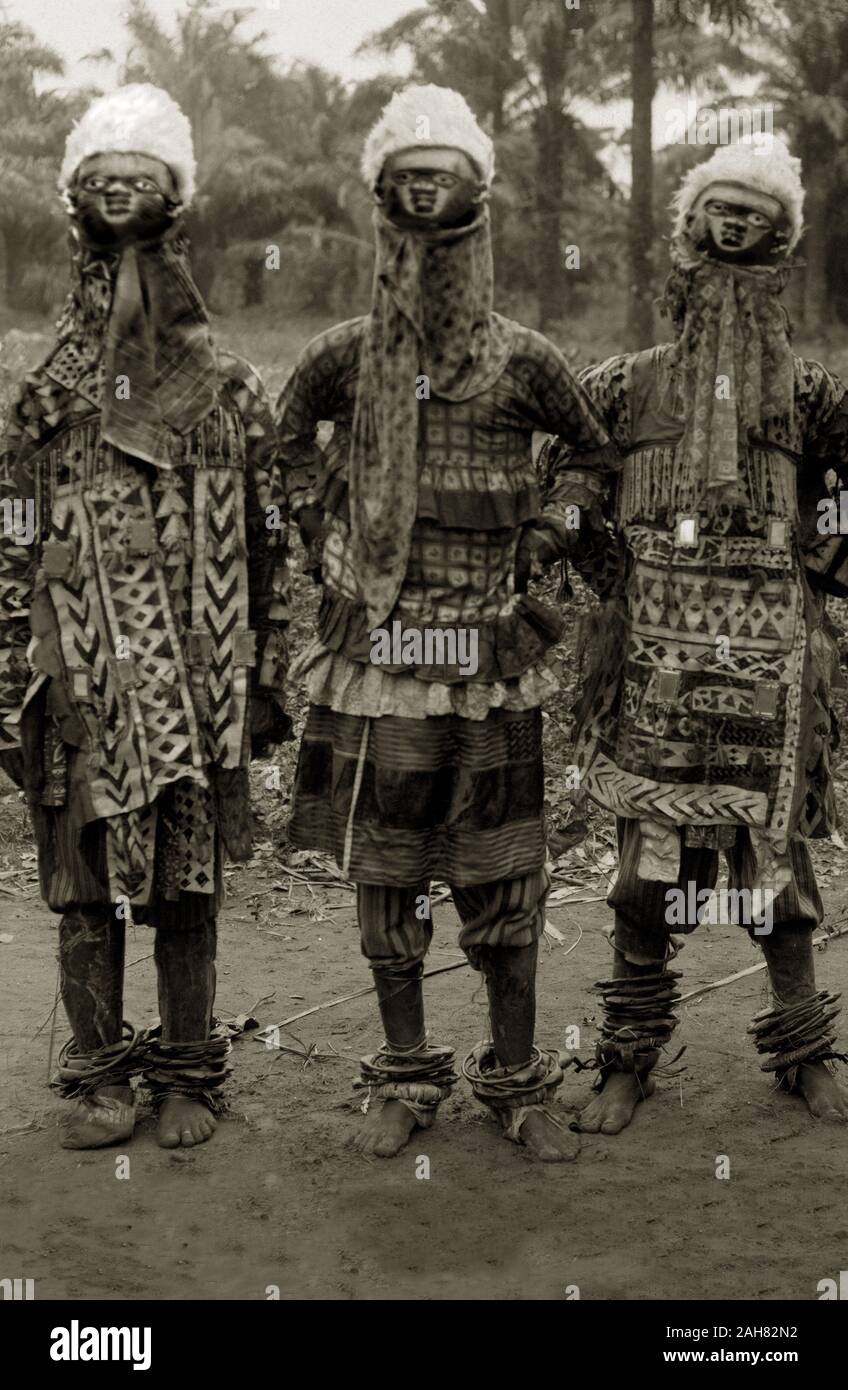
There is a room somewhere in Nigeria — in a native doctor’s compound in Benin City, in a madam’s parlour in Cotonou, in a shrine tucked behind the Lagos Third Mainland Bridge — where the future of 230 million people is being negotiated. Not by economists. Not by constitutional lawyers. Not at the ballot box. But by men in robes pouring libations, chanting over cowrie shells, and burying charms in the ground beneath government buildings.
This is not folklore. This is Nigerian political reality, and it is time someone said so plainly.

Every Nigerian who has lived long enough in this country knows the score. The juju man — or the spiritual madam, as the trade is increasingly female-dominated — is as integral to the Nigerian political ecosystem as the party primary, the campaign bus, and the brown envelope stuffed with cash. Before a governorship candidate files his nomination papers, he has almost certainly visited a native doctor. Before a senator takes his seat, he has likely been bound by oaths and bathed in concoctions that a Harley Street physician would find chemically inexplicable but a Benin herbalist would consider entirely routine. Power in Nigeria is spiritual first, political second.
I say this as a man who grew up in the West, who was educated at Eton and at Wharton, who does not personally subscribe to these beliefs. But I have watched Nigerian politics for long enough to know that what a man believes matters far less than what his political rivals believe. And in Nigeria, nearly everybody believes.

THE HOUSE ON THE HILL HAS ALWAYS BEEN HAUNTED
From General Sani Abacha to Abdulsalami Abubakar to Olusegun Obasanjo to Umaru Yar’Adua, successive occupants of Aso Rock have carried out spiritual cleansings of the presidential villa before moving in with their families and staff. This is not rumour. This is documented. A security officer who served at the Villa during both the Obasanjo and Yar’Adua years described it with clinical precision: under Obasanjo, different men of God were brought in to pray over and anoint every corner of the building; under Yar’Adua, Mallams — some reportedly imported from Chad and Niger — were brought to perform their own cleansing rites before the family moved in.
When Sani Abacha died suddenly in June 1998 — a death surrounded by its own atmosphere of dark rumour — his successor Abdulsalami was reportedly not given the all-clear to occupy the Villa for weeks while specialists methodically removed the spiritual infrastructure the late dictator had installed. Whatever Abacha had buried, planted, or bound into those walls had to be neutralised. The palace of Nigerian power does not come empty. It comes loaded.
Reuben Abati, the intellectual and broadcaster who served as President Goodluck Jonathan’s spokesman, wrote with unforgettable candour about what he experienced inside that compound. He described a situation where every principal officer suffered one tragedy or another during their time at the Villa — from cancer to brain and prostate surgery and worse — “as if you needed to sacrifice something to remain on duty inside that environment.” A man of that calibre, a PhD holder, a journalist of sceptical disposition, did not write those words lightly.
THE MARKET FOR MIRACLES IS BOOMING
Today, the Nigerian media is flooded with stories of pastors burying strange objects, including human parts, as the foundations of their churches. Islamic clerics who double as spiritual handlers for Yahoo Boys seeking occult fortification are raided almost daily. Human parts traders, when caught, regularly lead investigators back to pastors and clerics whose divination practices drive demand.
This is the ecosystem feeding Nigeria’s political class.
As the 2027 election cycle approaches, analysts and commentators already expect a surge in political gravitating toward black magic. One recent piece in the Sunday Tribune put it with scholarly honesty: the use of herbs, divination, witchcraft, and sorcery occupies a real and living part of daily Nigerian existence — not as backward superstition clinging to modernity’s margins, but as what theologian E. Bolaji Idowu called African Traditional Religion: a “contemporary living reality.”
It is a reality with a geography. The madams of Cotonou. The native doctors of Abeokuta. The Ogboni shrines of Lagos. The Ijele priests of the Igbo hinterland. The Babalawo networks that stretch from Ile-Ife across the diaspora to Brazil and Cuba. These are not peripheral figures in Nigerian political life. They are the consultants without portfolios, the invisible cabinet ministers whom no election petition has ever named but whose influence on outcomes many Nigerians would not dare dismiss.
THE PRESIDENT AND THE DARKNESS
I am not one to traffic in unverified allegations. But the record on the present occupant of Aso Rock carries its own texture.
At the inauguration of Rauf Aregbesola as second-term governor of Osun State in November 2014, then-APC national leader Bola Tinubu publicly called on Nigerians to prepare their charms and juju powers for the 2015 elections. These words were spoken in public, before an audience that included Muhammadu Buhari, party chairman Bisi Akande, and serving APC governors. No one present appeared to find this remarkable. In Nigeria’s political culture, it wasn’t.
Aregbesola himself — once Tinubu’s most trusted lieutenant, a man Tinubu mentored, bankrolled, and elevated to the governorship of Osun State — eventually publicly accused his former godfather of having turned himself into “a god,” of demanding a loyalty that went beyond the political and into something closer to fealty owed to a supernatural overlord. When a man who spent fifteen years in the inner sanctum describes his former patron in those terms, the language of the occult is not metaphorical.
Even the most sophisticated Nigerians carry amulets to ward off evil spells. Juju shrines dot roadsides throughout the country. The lines between spiritual protection, political dominance, and sheer terror have always been blurred in Nigerian public life. A politician’s hold over his subordinates is never purely financial. There is always the unspoken dimension — the oath taken, the object buried, the sacrifice made. The fear of what will happen if you betray the godfather is not merely fear of losing your ministerial slot. It is older than that.
THE DARK COST TO GOVERNANCE
Here is what gets overlooked in this conversation: the occult economy of Nigerian politics is not merely a cultural curiosity. It has a direct cost to governance.
When a politician spends significant sums — and some of these consultations run into millions of naira — at juju shrines rather than in hospitals, schools, or infrastructure, that is a resource allocation decision. When electoral outcomes are perceived as spiritually determined rather than politically earned, accountability vanishes. Why hold a governor responsible for failing his state when his mandate was written in the stars by a Babalawo in Ife? When political rivals operate in fear of one another’s spiritual arsenals, the space for rational policy debate collapses entirely.
Nigeria has brilliant economists, skilled engineers, world-class lawyers, and gifted administrators. What it lacks is a political culture that trusts human competence over spiritual intervention. Until the men and women who govern 230 million people accept that good governance is a product of hard work, transparent institutions, and accountability — not cowrie shells, sacrificed chickens, and buried charms — the country will remain trapped in a loop of mystical self-sabotage.
I grew up in the West. I am, as I readily admit, not an initiate into these mysteries. But I know what a failing state looks like. And I know that no Babalawo, however skilled, has ever repaired a broken power grid, funded a school, or balanced a budget.
The gods of Aso Rock are hungry. And it is always the people who pay.
Kio Amachree, President, Worldview International, contributed this article from Stockholm, Sweden