

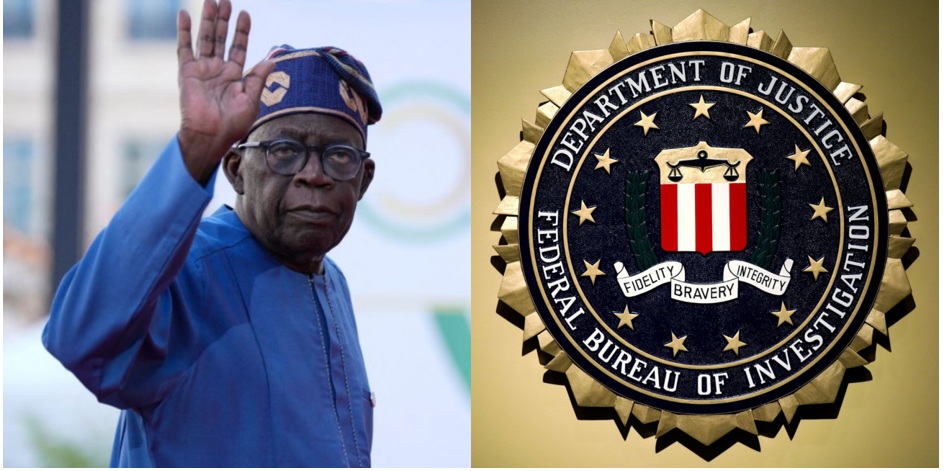
WASHINGTON — In a joint court filing dated November 27, 2026, the FBI and the Drug Enforcement Administration proposed extending proceedings in the long-running Freedom of Information Act case over President Bola Tinubu’s investigative records into March 2027.
President Tinubu, through his lawyers, formally endorsed the proposed delay, a move that would push any final ruling beyond Nigeria’s upcoming presidential election.

The filing was made in Aaron Greenspan v. Executive Office for U.S. Attorneys, the case seeking U.S. government records relating to investigations of a Chicago-based money-laundering and heroin-trafficking operation during the early 1990s.
The latest filing also identifies a redacted 1992 FBI document listing members of a Nigerian heroin trafficking organization. Other withheld records at issue concern wiretaps, financial transactions, and asset seizures. The FBI has acknowledged under oath that additional information may be released.

For those who have pushed for disclosure, the delay, if granted, is irrelevant.
The objective, they say, was to ensure that senior members of the Donald Trump administration and Congress were fully briefed on the issues, and that President Tinubu was denied the endorsement and support he sought from President Donald Trump. A reported $9 million lobbying effort, in that view, went up in smoke.
Nevertheless, President Tinubu’s desire to delay the court’s ruling until after the upcoming Nigerian presidential election is telling but pointless, critics argue. It is well understood by millions in Nigeria and around the world, they contend, that the allegations that President Tinubu was part of a criminal organization that smuggled heroin from Nigeria to the United States during the 1980s and 1990s are likely true.
Background:
A Case That Has Outlasted Three Decades
The current fight traces back to a U.S. federal investigation in the early 1990s into an alleged Chicago-based heroin-trafficking and money-laundering network in which Tinubu and his alleged associate, Abiodun Agbele, were named.
In 1993, Tinubu forfeited $460,000 to the U.S. government in a civil forfeiture action linked to that investigation. Tinubu has long maintained that the funds were from legitimate business and that he was never charged with, or convicted of, any drug offence in the United States. His supporters have repeatedly cited that point in dismissing the allegations.
The FOIA litigation, filed in 2023, seeks the underlying investigative files that the government has kept largely sealed or heavily redacted for more than 30 years.
On October 30, 2026, Judge Beryl A. Howell of the U.S. District Court for the District of Columbia delivered a 78-page memorandum opinion that rejected substantial parts of the FBI and DEA’s attempts to justify withholding records.
Judge Howell ordered both agencies to go back, review the files against the public record, and provide detailed, itemized justifications for why any portions should remain secret by November 27, 2026.
Instead of full compliance on that date, the agencies filed for more time.
The FBI had already signaled the move days earlier. In a declaration dated November 24, 2026, by Melissa A. Corcoran, the FBI’s Section Chief of the Record/Information Dissemination Section, the bureau requested at least 60 additional days to explain why it continues to withhold portions of records linked to the historical investigation.
The November 27 joint filing formalizes that request into a proposed schedule extending into March 2027.
The case, registered as Civil Action No. 23-cv-1816, centres on FOIA requests seeking investigative records linked to an alleged drug trafficking and money laundering network that operated in the Chicago area during the early 1990s.
What happens next now rests with Judge Howell: whether to grant the extension, impose a tighter deadline, or order release of the disputed material.
For Tinubu’s critics, the timing is the story. A ruling delayed until after the election, they argue, would spare the president a politically damaging disclosure during the campaign. For Tinubu’s legal team, the extension is presented as a routine procedural step to allow the agencies to complete a careful, lawful review.
Either way, the files at the heart of the case — wiretaps, financial trails, seizure records, and the 1992 list of alleged organization members — remain out of public view, more than three decades after they were created.