

By Kio Amachree
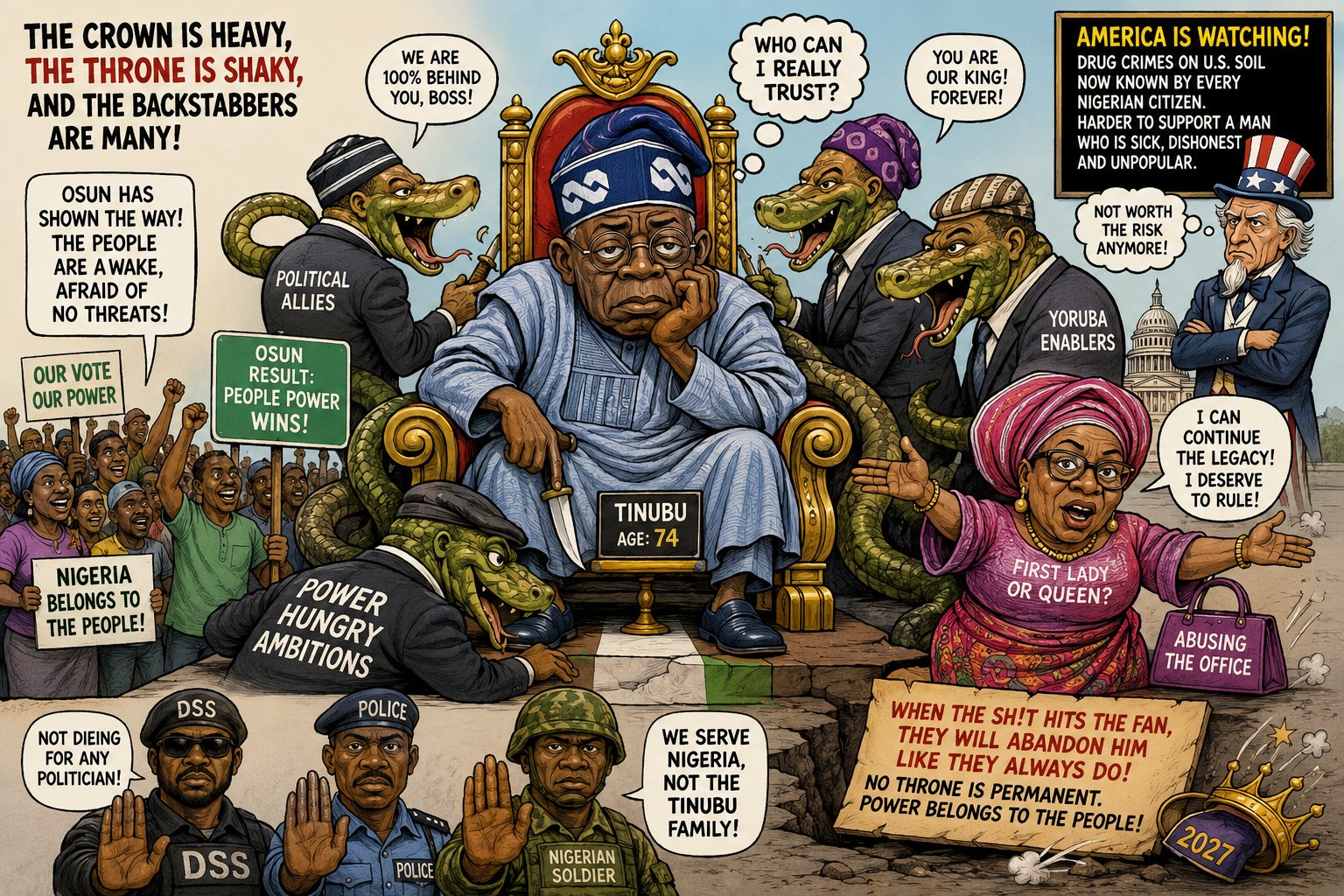
I will make a prediction: if Bola Ahmed Tinubu eventually loses power, the decisive blow may not come from the opposition alone. It may come from the very political establishment that helped put him there.

History is full of would-be kings who believed loyalty lasted forever, only to discover that political friendship often survives only while power remains useful.
The warning signs are appearing.

The Osun governorship election should concern every strategist around the President. Governor Ademola Adeleke won re-election despite a fiercely contested campaign, and the result is already being interpreted by some as a warning for the APC ahead of 2027.
Osun demonstrated something important: an incumbent political machine is not invincible when voters are sufficiently determined to turn out.
And that changes political calculations.
The men surrounding a powerful President may praise him today, defend him on television and assure him privately that everything is under control. But politicians also calculate their own survival. When association with a leader becomes more expensive than abandoning him, loyalty can disappear remarkably quickly.
That is why I believe Tinubu should be watching his supposed friends very carefully.
His administration also carries the burden of controversies surrounding his past. The American forfeiture case connected with funds in U.S. bank accounts has been discussed so extensively in Nigeria that it is no longer an obscure historical matter known only to lawyers and investigative journalists.
For Washington and Nigeria’s other international partners, reputation matters. The more controversial questions surrounding a head of state become part of mainstream political discussion, the more difficult those questions become to ignore.
Tinubu’s political strength must also be examined.
Recent polling putting his approval at roughly 30 percent represents a serious political warning for an incumbent preparing for another national election.
Then there is the security establishment.
Anyone imagining that every DSS officer, policeman or Nigerian soldier will automatically sacrifice himself for the political survival of one family misunderstands the difference between loyalty to the Nigerian state and loyalty to an individual politician.
The armed forces, police and intelligence services belong to Nigeria, not to Bola Tinubu, not to the APC and certainly not to any presidential family.
The same principle applies to the First Lady. Oluremi Tinubu has every right to participate in public life, but Nigeria is a constitutional republic, not a monarchy. The presidency is not hereditary. No wife, son, daughter or political dynasty possesses an automatic claim to succession.
And this is where Tinubu’s greatest danger may eventually lie.
When political weather changes, today’s loudest loyalists can become tomorrow’s historians explaining why they were never really loyal in the first place.
The Yoruba politicians around him will calculate.
The northern establishment will calculate.
Governors will calculate.
Business interests will calculate.
Security officials will calculate.
Foreign governments will calculate.
And above all, the Nigerian people will calculate.
Osun has reminded the country that votes still matter when citizens insist upon exercising them.
Tinubu’s political machine remains formidable. Anyone pretending otherwise is underestimating an experienced political operator.
But formidable is not the same thing as immortal.
No political dynasty lasts forever.
No alliance lasts forever.
And no President owns Nigeria.
The ultimate question for 2027 is therefore not whether Tinubu’s political machine is powerful. It unquestionably is.
The question is whether the Nigerian people’s determination to choose their own future becomes more powerful than the machine.
Amachree first published this article on X