

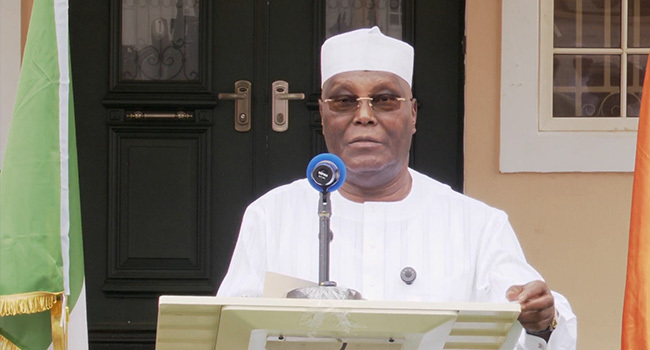
“Tinubu cannot call this reform when the people who grow our food and the businesses that should process it are being squeezed from both sides,” Atiku said.
Former Vice President and ADC presidential candidate Atiku Abubakar has accused President Bola Tinubu of presiding over a collapse in agricultural export earnings while farmers struggle with insecurity and manufacturers confront punishing production costs.

He said an administration that promised to build a productive economy has left Nigeria selling crops abroad without capturing enough of the processing jobs and value they can generate at home.
“Tinubu cannot call this reform when the people who grow our food and the businesses that should process it are being squeezed from both sides,” Atiku said.

In a statement issued by the Director of Strategic Communication of the ADC Presidential Campaign Council, Phrank Shaibu, Atiku said the trade figures expose the scale of the failure.
Nigeria’s agricultural trade swung from a ₦740.27 billion surplus in the first half of 2025 to a ₦56.13 billion deficit in the first half of 2026—a ₦796.40 billion reversal in one year. Agricultural exports fell by 33.3 per cent, far faster than imports, which also declined.
“The excuse that Nigerians simply imported too much will not stand. Tinubu’s government must answer for the collapse in what Nigeria sold to the world. The country is losing export earnings, and the President owes farmers, workers and businesses more than another speech about prosperity.
“What has his administration done to make it safer to farm, cheaper to move produce, easier to keep a processing plant running or more profitable to sell a finished Nigerian product abroad? Farmers cannot cultivate promises. Manufacturers cannot power factories with speeches. Workers cannot feed their families on assurances that prosperity is coming.”
Atiku said Nigeria’s leading agricultural exports still include cashew nuts in shell and cocoa beans, illustrating the value the country could retain by expanding domestic processing.
“We grow the crop. Someone else does more of the processing, builds a business around it and earns the larger return. Then Tinubu speaks of jobs while Nigerian factories struggle to compete. He has made production expensive and called the resulting hardship reform.
“A trade deficit alone does not explain every problem on our farms. But after more than three years in office, the President owns the decisions that have left farmers exposed and producers burdened. He cannot claim credit for every favourable statistic and disown a ₦796.40 billion reversal when the figures turn against him.”
Atiku said his proposed production subsidy for petroleum products refined in Nigeria follows the same principle: keep more production, work and value at home. The support would cover qualifying products from Nigerian refineries, including modular refineries. Imported products would not qualify. It would be capped, budgeted and independently audited, with measures to track whether savings reach consumers and businesses.
He said the Tinubu administration’s CNG initiative had failed abysmally as a relief measure: the cost of converting vehicles is beyond the reach of many poor Nigerians, conversion kits are difficult to access, and the buses presented as palliatives remain unavailable to many of the people who need them.
“Local refining is about more than the price at the petrol pump. Aviation fuel affects fares. LPG affects the cost of cooking. Petroleum products and feedstocks affect industries and the people they employ. Nigerians need practical relief they can actually access—not schemes whose costs and shortages put the promised benefits out of reach. The value of our resources must reach Nigerians beyond the refinery gate.
“My administration will begin restoring a transparent production subsidy from Day One. We will back farmers and processors with the same determination. Grow it here. Process it here. Refine it here. Create the jobs here. Make life affordable here.
“Tinubu’s record is becoming painfully clear: Nigeria supplies raw crops and crude oil while Nigerians pay dearly for finished goods. A government that cannot turn our resources into affordable products and decent jobs has failed the people it was elected to serve.”
US proposes $70,000 fee for Nigerians, other foreign students seeking to work in U.S.
President Donald Trump’s administration has proposed $70,000 or $30,000 for F-1 fees for nonimmigrant students from Nigeria and other countries seeking temporary employment authorisation in the U.S.
The U.S. Department of Homeland Security on Wednesday announced that the latest proposed rule “If finalised, would implement new fees for F-1 nonimmigrant students seeking to participate in Optional Practical Training (OPT), a temporary employment authorization connected to a student’s field of study.”
It added, “The proposed rule would establish a $70,000 fee per F-1 nonimmigrant student for initial OPT and a $30,000 fee per F-1 nonimmigrant student for any subsequent OPT.”
The DHS said the proposed fees were aimed at reducing “the flow of cheap labor into the United States and make it easier for American citizens to compete in the job market and to combat fraud and abuse, strengthen the integrity of the immigration system, and protect U.S. workers.”
The DHS said it would welcome public comments and inputs on the proposed rule from October 8 through November 9. Additionally, the Paperwork Reduction Act section of the rule will have a 60-day public comment period.
According to DHS, “Existing federal regulations allow eligible F-1 nonimmigrant students to engage in OPT if the OPT is directly related to the student’s major area of study. To participate, F-1 nonimmigrant students must receive a recommendation from their designated school official (DSO) and apply for employment authorization with U.S.”
However, the new rule was proposed in response to fraud and abuse identified by the Student and Exchange Visitor Program (SEVP).
“As more F-1 nonimmigrant students have participated in OPT, SEVP has encountered schools, designated school officials, employers, and F-1 nonimmigrant students engaged in schemes to exploit current regulations, including problematic worksites and “pay-to-stay” visa schemes,” the DHS said.
It added, “The proposed fees would encourage schools to exercise greater oversight and selectivity when recommending F-1 nonimmigrant students for OPT, helping reduce fraud and strengthen program integrity.”